Is a Dehumidifier Cheaper Than Heating? Complete Cost Analysis for 2026
Is a Dehumidifier Cheaper Than Heating? Complete Cost Analysis for 2026
A dehumidifier cheaper than heating approach works because humid air feels colder at the same temperature. A typical 500-watt dehumidifier costs roughly $0.48–0.64 daily to run, while a 1,500-watt space heater costs $1.44–1.92 for the same runtime. This guide breaks down exactly when each option saves you money.
Understanding Energy Consumption: Dehumidifiers vs Heaters
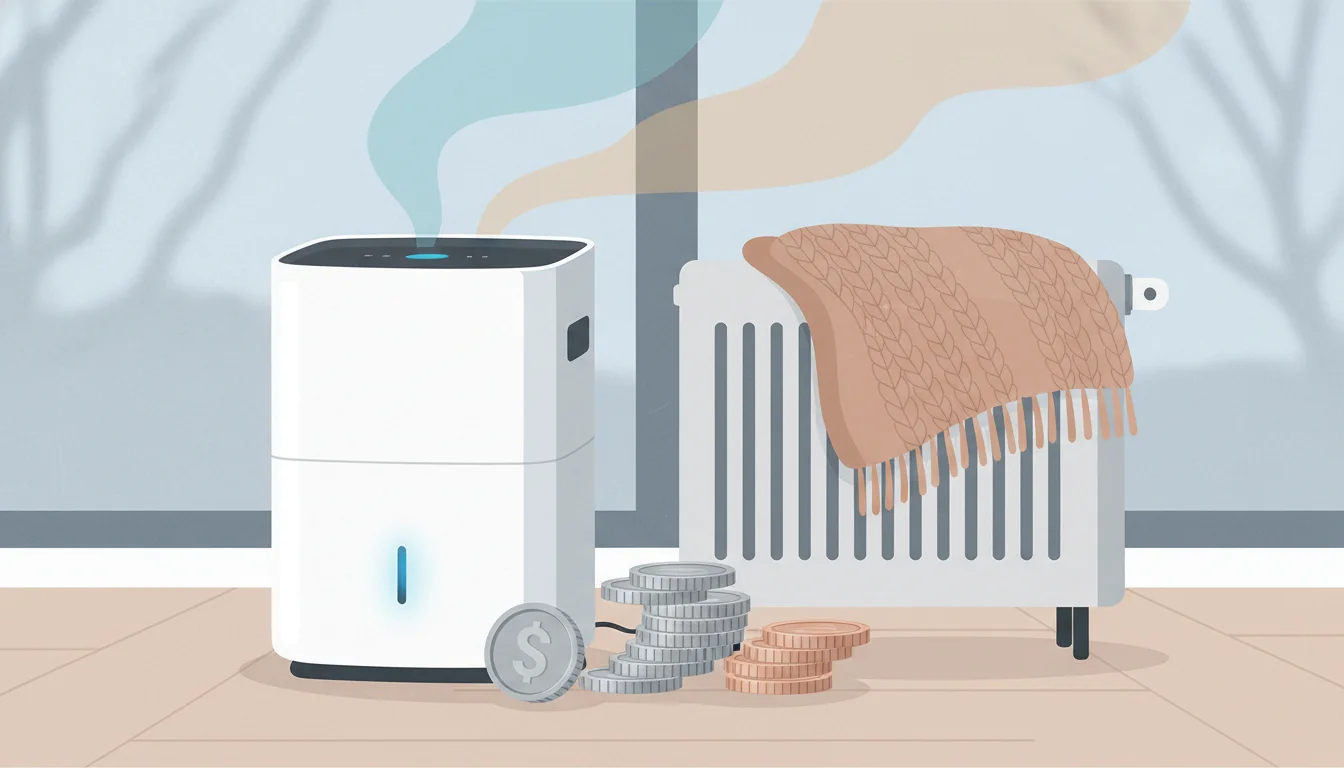
Residential dehumidifiers draw 300–700 watts per hour—roughly one-third to one-half what electric space heaters consume at 1,000–1,500 watts continuously.
| Appliance Type | Wattage Range | Monthly kWh (8 hrs/day) | Heat Output |
|---|---|---|---|
| Residential Dehumidifier | 300–700W | 72–168 kWh | Yes (byproduct) |
| Electric Space Heater | 1,000–1,500W | 240–360 kWh | Primary function |
| Heat Pump Dehumidifier | 200–500W | 48–120 kWh | Yes (enhanced) |
| Central Heating (electric) | 3,000–5,000W | Varies widely | Primary function |
Here's what most people miss: every dehumidifier doubles as a heater. Condensing 1 liter of water releases approximately 0.7 kilowatt-hours of heat as a byproduct. Your 500-watt dehumidifier functions simultaneously as a 500-watt electric heater, with bonus efficiency from the condensation process.
Energy Star certified dehumidifiers use about 13% less energy than standard models, according to Perch Energy. Heat pump dehumidifiers take efficiency even further, consuming 30–50% less energy than traditional compressor models to remove the same amount of moisture.
Real Cost Comparison: Running a Dehumidifier vs Heating
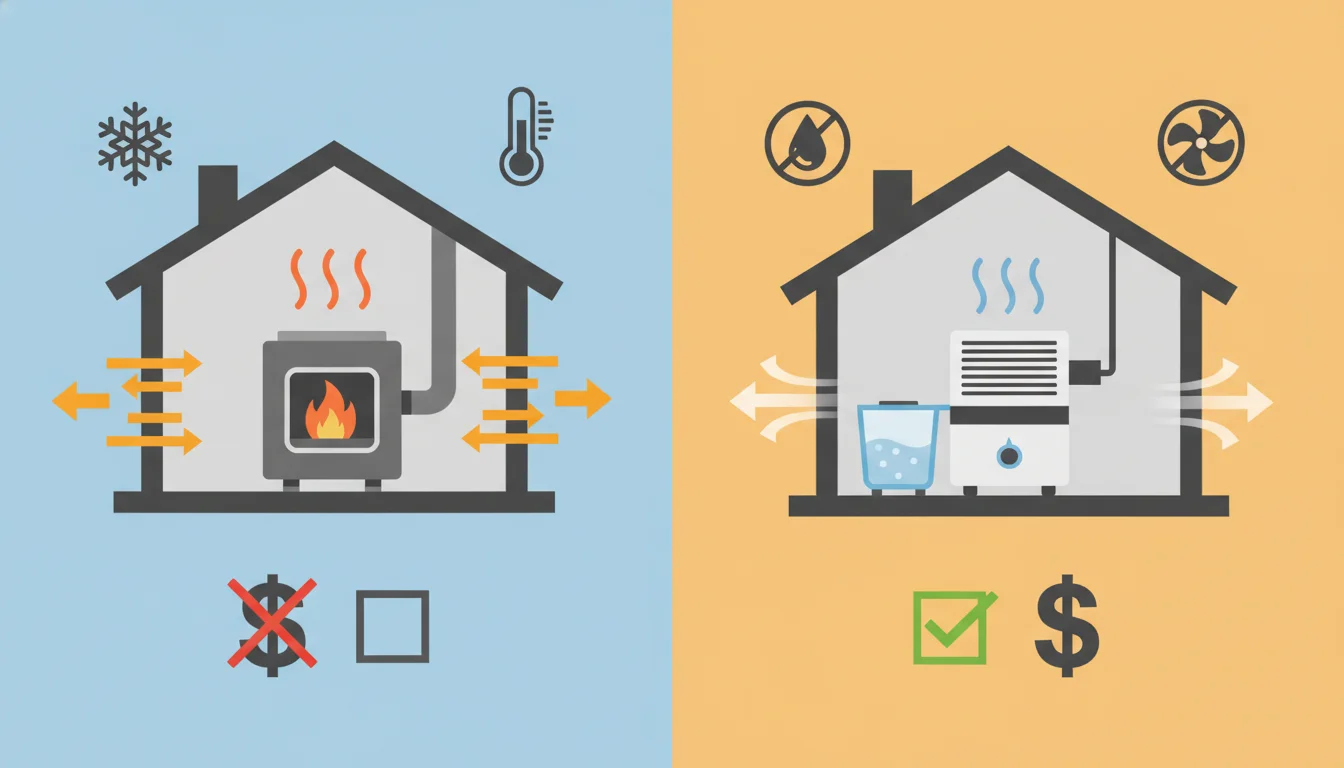
Running a dehumidifier costs 50–70% less than electric heating for the same operational hours, with exact savings depending on your local electricity rates.
| Scenario | Daily Cost | Monthly Cost | Annual Cost (6 months) |
|---|---|---|---|
| 500W Dehumidifier @ $0.12/kWh | $0.48 | $14.40 | $86.40 |
| 500W Dehumidifier @ $0.16/kWh | $0.64 | $19.20 | $115.20 |
| 1,500W Heater @ $0.12/kWh | $1.44 | $43.20 | $259.20 |
| 1,500W Heater @ $0.16/kWh | $1.92 | $57.60 | $345.60 |
The math tells a clear story. Switching from an electric heater to a dehumidifier during appropriate conditions saves $28.80–$38.40 monthly. Over a heating season, that adds up to $172.80–$230.40.
Regional electricity rates shift these numbers significantly. California residents paying $0.25/kWh see dehumidifier costs of $1.00 daily versus $3.00 for heating. Louisiana residents at $0.09/kWh pay just $0.36 versus $1.08. Your local rate determines whether savings are modest or substantial.
A fair warning: these calculations assume you're replacing heating entirely with dehumidification. Real savings often come from using both strategically—which we'll cover below.
When Does a Dehumidifier Make Sense Over Heating?
The sweet spot sits between 50–65°F with humidity above 60%. In these conditions, removing moisture makes air feel 3–5 degrees warmer without generating actual heat.
- Best conditions: Mild temperatures with indoor humidity exceeding 60%
- Ideal spaces: Basements, coastal homes, rooms with poor ventilation
- Peak seasons: Spring and fall transitional months
- Regional fit: Pacific Northwest, Gulf Coast, Great Lakes regions
- Limitation: Below 50°F, you need actual heating regardless of humidity
I learned this the hard way in a damp basement apartment. Running the dehumidifier dropped humidity from 72% to 50%, and the space felt noticeably warmer—even though the thermostat read the same temperature. My body didn't care about the numbers.
Kullhaus research found that well-controlled humidity reduces heating energy demand by about 20% because drier air heats faster. Less energy gets wasted warming moisture molecules.
For northern states with harsh winters, dehumidifiers supplement but never replace heating systems. For southern and coastal regions with mild, damp winters, a dehumidifier alone handles many days comfortably.
The Hidden Benefits: Comfort and Health Beyond Cost Savings
Lower humidity delivers health and structural benefits that compound your savings over time through reduced maintenance, medical costs, and replacement expenses.
- Mold prevention: Humidity below 50% stops mold growth, eliminating remediation costs averaging $1,500–$3,000
- Dust mite reduction: These allergens thrive above 50% humidity and die off below it
- Structural protection: Wood floors, furniture, and framing last longer without moisture damage
- Allergy relief: Reduced mold spores and dust mites mean fewer symptoms and medications
- Paint and wallpaper: Peeling and bubbling from moisture becomes a non-issue
The U.S. Department of Energy recommends maintaining indoor humidity between 30–50% for optimal comfort and efficiency. This range happens to be exactly where dehumidifiers perform best.
Trust me on this: preventing one mold remediation project pays for years of dehumidifier operation. The cost comparison shifts dramatically when you factor in what moisture damage actually costs.
Smart Strategies: Combining Dehumidifiers and Heating for Maximum Savings
The most cost-effective approach uses dehumidification to lower your thermostat setting by 2–4 degrees while maintaining the same comfort level.
| Season | Primary Strategy | Secondary Support | Target Humidity |
|---|---|---|---|
| Early Fall | Dehumidifier only | None needed | 45–50% |
| Late Fall | Dehumidifier + low heat | Reduce thermostat 3°F | 40–45% |
| Winter | Heating primary | Dehumidifier in problem areas | 35–40% |
| Early Spring | Dehumidifier + low heat | Reduce thermostat 3°F | 40–45% |
| Late Spring | Dehumidifier only | None needed | 45–50% |
Zone-based dehumidification saves the most money. Run a dehumidifier in your basement or problem room rather than cranking whole-home heating. You target moisture where it accumulates without conditioning your entire house.
Smart dehumidifiers with built-in humidity sensors optimize automatically. Set your target humidity, and the unit cycles on and off as needed—no babysitting required. Models with programmable timers let you run during off-peak electricity hours for additional savings.
Maintenance matters more than people realize. Clean filters monthly and empty reservoirs before they trigger auto-shutoff. A clogged dehumidifier works harder and uses more electricity for worse results.
Choosing an Energy-Efficient Dehumidifier for Cost Savings
Energy Star certification and proper sizing determine whether your dehumidifier delivers promised savings or becomes another energy drain.
- Energy Star models: Use 13–15% less energy than standard units with identical capacity
- Integrated Energy Factor (IEF): Higher ratings mean more moisture removed per kWh consumed
- Capacity matching: 30-pint for spaces under 1,000 sq ft, 50-pint for 1,000–2,000 sq ft
- Compressor type: Standard compressors work best above 65°F; desiccant models handle colder spaces
- Auto-shutoff: Prevents overflow and unnecessary operation when the reservoir fills
- Continuous drain option: Eliminates manual emptying for basement installations
Oversized units cycle on and off too frequently, wasting energy on startup surges. Undersized units run constantly without reaching target humidity. Either mistake kills your cost savings.
For temperatures below 65°F, consider desiccant dehumidifiers. Compressor models lose efficiency in cold conditions and may frost over. Desiccant technology maintains performance down to 40°F.
FAQ
Does a dehumidifier heat a room?
A dehumidifier generates heat as a byproduct of its compression cycle, typically adding 2–5°F to room temperature during operation. This heat output functions like a small space heater while simultaneously removing moisture.
How many hours per day should I run a dehumidifier?
Most homes need 8–12 hours of daily dehumidifier operation to maintain 45–50% humidity. Use a hygrometer to monitor levels and adjust runtime based on your specific conditions and target humidity.
Do dehumidifiers work in cold rooms?
Standard compressor dehumidifiers lose efficiency below 65°F and may frost over below 50°F. Desiccant dehumidifiers work effectively down to 40°F, making them better choices for unheated basements and garages.
Is it cheaper to run a dehumidifier or air conditioner?
Dehumidifiers cost less to operate than air conditioners for humidity control alone. A dehumidifier uses 300–700 watts versus 1,000–3,500 watts for window AC units, though AC provides both cooling and dehumidification.
Can I use a dehumidifier instead of heating in winter?
In mild winters with temperatures above 50°F, dehumidification alone maintains comfort for some people. Below 50°F, you need actual heating regardless of humidity levels. The most effective approach: use both together and lower your thermostat.
What humidity level feels warmest?
Humidity between 40–50% feels warmest at any given temperature because dry air doesn't conduct heat away from your body as efficiently. Reducing humidity from 70% to 45% makes a room feel 3–5°F warmer.
How much does it cost to run a dehumidifier 24/7?
A 500-watt dehumidifier running 24/7 at $0.14/kWh costs approximately $50.40 monthly. Running only 8–12 hours daily cuts this to $16.80–$25.20 monthly while still controlling humidity effectively.
Share this post
Related Articles
Would a Dehumidifier Help With Asthma? What Science Says in 2026
Would a Dehumidifier Help With Asthma? What Science Says in 2026
Best Dehumidifier for RV: Complete Buyer's Guide for 2026
Best Dehumidifier for RV: Complete Buyer's Guide for 2026
Will a Dehumidifier Get Rid of Silverfish? Complete Guide to Humidity-Based Pest Control
Will a Dehumidifier Get Rid of Silverfish? Complete Guide to Humidity-Based Pest Control