Best Dehumidifier for RV: Complete Buyer's Guide for 2026
Best Dehumidifier for RV: Complete Buyer's Guide for 2026
A dehumidifier for RV use removes excess moisture from your camper's air, preventing mold growth and structural damage. Daily activities like cooking, showering, and breathing add 5-10 liters of water vapor to your RV's compact interior. This guide covers sizing, power requirements, and the best models to keep your camper dry and healthy.
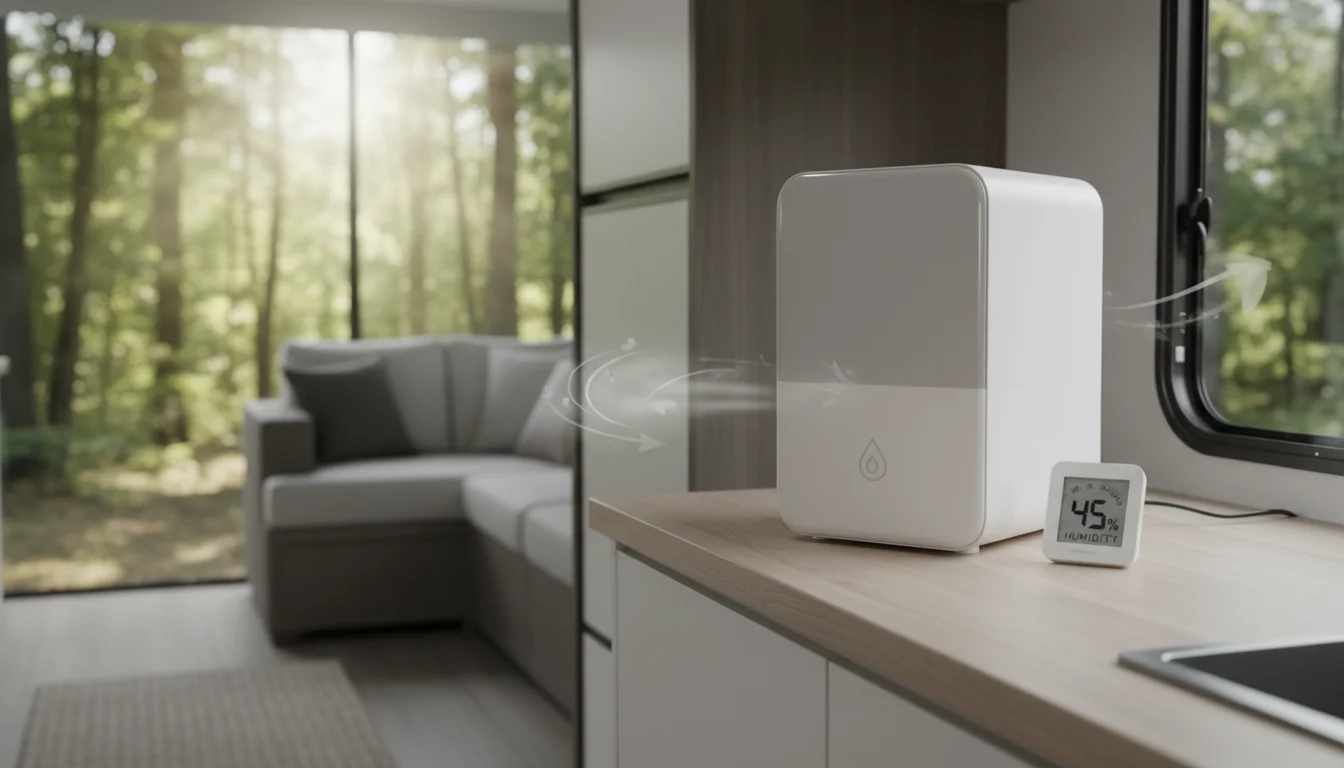
Why Your RV Needs a Dehumidifier
Moisture accumulates fast in RVs because small spaces trap humidity from everyday living. Your body alone releases about 1 liter of water vapor daily through breathing.
Here's what creates moisture in your RV:
- Cooking and boiling water adds steam directly to the air
- Showering without proper ventilation traps humidity
- Breathing and perspiration from occupants, especially overnight
- Wet gear, clothes, and shoes brought inside
- External humidity seeping through doors, windows, and seams
Signs you have a moisture problem:
- Condensation forming on windows, especially in the morning
- Musty, stale odors that won't go away
- Visible mold spots in corners, closets, or under mattresses
- Damp-feeling bedding or upholstery
- Warped wood or peeling laminate
The health risks are real. Mold exposure triggers allergies, asthma attacks, and respiratory infections. Kids and older adults face higher risks.
Keep your RV humidity between 30-50% relative humidity. A $15 hygrometer tells you exactly where you stand. Above 60%, mold starts growing within 24-48 hours according to Indoor Doctor.
Long-term damage hits your wallet hard. Rotted wood, rusted metal frames, ruined upholstery, and degraded seals cost thousands to repair. I've seen RVs totaled because owners ignored moisture for one season too long.
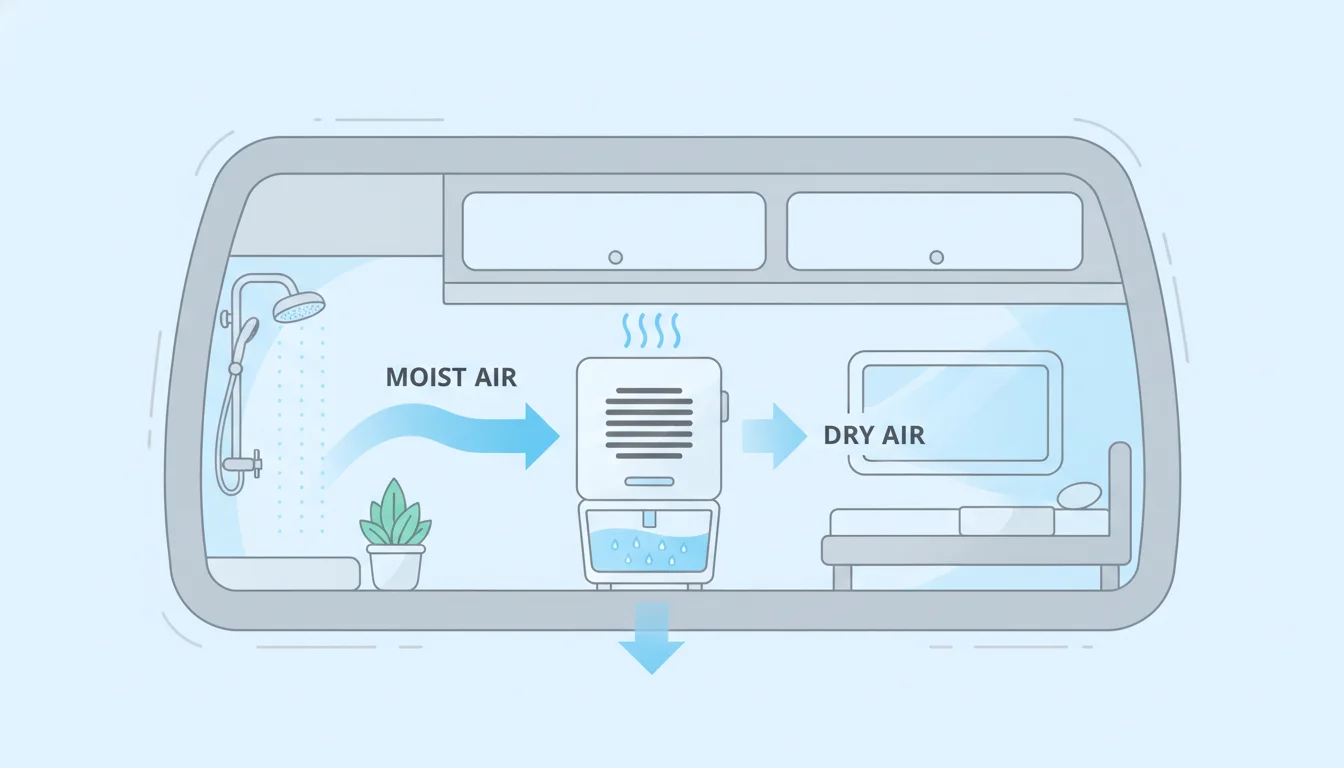
Compressor vs Desiccant Dehumidifiers: Which Is Best for RVs?
Compressor dehumidifiers work best for RVers in warm, humid climates who need serious moisture removal. Desiccant models suit cooler temperatures and off-grid camping.
| Feature | Compressor | Desiccant | Thermo-Electric (Peltier) |
|---|---|---|---|
| Best Temperature Range | 65°F and above | 40°F and above | 60°F and above |
| Moisture Removal | 20-50 pints/day | 10-25 pints/day | 8-20 oz/day |
| Power Draw | 300-700 watts | 200-400 watts | 20-70 watts |
| Noise Level | Moderate to loud | Quiet | Near silent |
| Price Range | $150-$400 | $100-$300 | $30-$80 |
| Best For | Full-time RVing, humid climates | Winter camping, storage | Small spaces, boondocking |
Compressor units pull air over cold coils, where water condenses and drips into a tank. These work great in Florida, Texas, or coastal areas but struggle below 65°F because the coils freeze up.
Desiccant dehumidifiers use a moisture-absorbing material that's heated to release water. They operate in freezing temperatures, making them perfect for winter storage or camping in the Pacific Northwest.
Thermo-electric mini units are the budget option. They remove ounces, not pints—fine for a Class B van or small storage area, but don't expect them to handle a travel trailer.
If you camp year-round in varying climates, a desiccant model gives you the most flexibility. If you're a snowbird chasing warm weather, compressor units deliver more moisture removal per dollar.
How to Size a Dehumidifier for Your RV
Match your dehumidifier's pint capacity to your RV's square footage and local humidity levels. Undersized units run constantly without keeping up.
| RV Type | Square Footage | Humidity Level | Recommended Capacity |
|---|---|---|---|
| Class B / Small Camper | Under 150 sq ft | Moderate (50-60%) | 10-20 pints |
| Travel Trailer | 150-400 sq ft | Moderate (50-60%) | 20-30 pints |
| Travel Trailer | 150-400 sq ft | High (70%+) | 30-35 pints |
| Fifth Wheel / Class A | 300-500 sq ft | Moderate (50-60%) | 30-40 pints |
| Fifth Wheel / Class A | 300-500 sq ft | High (70%+) | 40-50 pints |
Calculate your RV's square footage by multiplying interior length by width. A 28-foot travel trailer that's 8 feet wide has roughly 224 square feet of living space.
Climate matters as much as size. Camping in Arizona? A smaller unit handles the job. Parking near the Gulf Coast? Size up.
The continuous drain option saves you from emptying tanks twice daily in humid conditions. Look for units with a hose connection and run the hose into your shower drain or out a window. Camping World recommends continuous drain setups for anyone running their dehumidifier more than a few hours daily.
Fair warning: I bought a 20-pint unit for my 320-square-foot fifth wheel thinking I'd save money. I spent the whole summer emptying tanks and fighting humidity. Upgrading to 35 pints made an immediate difference.
Power Consumption and Electrical Requirements
RV dehumidifiers draw between 200-500 watts depending on type and capacity. Your electrical setup determines which units you can run without tripping breakers.
| Dehumidifier Type | Wattage Range | Daily kWh (12 hrs) | Monthly Cost* |
|---|---|---|---|
| Thermo-electric Mini | 20-70W | 0.24-0.84 kWh | $1-3 |
| Small Desiccant | 200-300W | 2.4-3.6 kWh | $7-11 |
| Mid-size Compressor | 300-500W | 3.6-6.0 kWh | $11-18 |
| Large Compressor | 500-750W | 6.0-9.0 kWh | $18-27 |
*Based on $0.15/kWh national average
A 30-amp RV service provides about 3,600 watts total. Running a 500-watt dehumidifier alongside your air conditioner, refrigerator, and microwave requires load management—run the dehumidifier when the AC cycles off.
A 50-amp service gives you 12,000 watts of headroom, so you can run what you want, when you want.
Boondockers face tougher choices. A 500-watt dehumidifier drains a 200Ah battery bank in under 5 hours. Stick to thermo-electric models drawing 20-70 watts for dry camping. They won't remove as much moisture, but they won't kill your batteries either. Jackery provides detailed calculations for sizing solar and battery systems around dehumidifier loads.
Energy-efficient features that actually matter:
- Humidistat controls cycle the unit on and off automatically
- Auto-shutoff when the tank fills prevents overflow and wasted energy
- Defrost mode keeps compressor units running efficiently in cooler temperatures
Top RV Dehumidifier Brands and Models
Eva-Dry, Frigidaire, hOmeLabs, and Pro Breeze lead the RV dehumidifier market with models ranging from $30 budget units to $400 high-capacity workhorses.
| Brand | Best Model for RVs | Capacity | Price Range | Standout Feature |
|---|---|---|---|---|
| Eva-Dry | E-333 | Renewable (no water tank) | $25-40 | No power needed, rechargeable |
| Eva-Dry | EDV-1200 | 20 pints/day | $120-150 | Compact with auto-shutoff |
| hOmeLabs | HME020031N | 22 pints/day | $160-200 | Best value, quiet operation |
| Frigidaire | FFAD2233W1 | 22 pints/day | $180-220 | Reliable brand, continuous drain |
| Pro Breeze | PB-03-US | 52 oz/day | $50-70 | Ultra-compact for small RVs |
| Frigidaire | FFAD3533W1 | 35 pints/day | $250-300 | High capacity for large RVs |
Budget picks ($30-80): Eva-Dry E-333 renewable units need no power and work great for storage or supplemental moisture control. Pro Breeze makes solid compact electric units for Class B vans.
Mid-range ($100-200): hOmeLabs delivers the best value—quiet enough to sleep through, powerful enough to handle most travel trailers. The Eva-Dry EDV-1200 fits tight spaces while still moving serious moisture.
Premium ($200-400): Frigidaire's larger compressor units handle fifth wheels and Class A motorhomes. Look for Energy Star certification and continuous drain capability.
Features worth paying extra for:
- Auto-defrost prevents coil freeze-up in cooler temperatures
- Continuous drain port eliminates tank emptying
- Washable filters save on replacement costs
- Caster wheels make repositioning easy
- Digital humidistat for precise humidity control
Check warranty terms. Compressor units should carry at least 1-year coverage, and some brands offer 2-year warranties on compressors specifically.
Installation, Placement, and Maintenance Tips
Position your dehumidifier in a central location with 12 inches of clearance on all sides for proper airflow. Corners and closets restrict performance.
Best placement practices:
- Central living area allows air to circulate from all directions
- Away from walls by at least 6 inches minimum
- Off the floor on a stable platform if your RV gets dusty
- Near problem areas like the bathroom or kitchen if moisture concentrates there
- Away from heat sources like space heaters, sunny windows, or cooking areas
Setting up continuous drainage:
- Connect a garden hose to the drain port
- Route the hose to your shower drain, sink, or outside
- Ensure the hose runs downhill with no kinks
- Secure the hose so it won't pop out
Maintenance schedule that keeps units running for years:
- Weekly: Check and empty the water tank if not using continuous drain
- Monthly: Clean or rinse the air filter
- Quarterly: Vacuum the intake grilles and inspect coils for dust buildup
- Before storage: Run the unit until bone dry, clean all filters, store upright
I'll be honest: I skipped quarterly coil cleaning for a year, and my unit's efficiency dropped noticeably. Fifteen minutes with a vacuum attachment brought it back to full performance.
Combine your dehumidifier with proper ventilation. Crack a window, run roof vents, or use a small fan to keep air moving. The dehumidifier works with your ventilation, not instead of it.
Alternative Moisture Control Methods
Moisture absorbers and proper ventilation handle light humidity problems and supplement electric dehumidifiers in storage situations. They won't replace a dehumidifier in humid climates.
| Method | Best For | Limitations | Cost |
|---|---|---|---|
| DampRid/Moisture Absorbers | Storage, closets, mild humidity | Needs frequent replacement, limited capacity | $5-15 per refill |
| Roof Vent Fans | Active ventilation while occupied | Requires power, lets in dust/bugs | $100-300 installed |
| Vent Covers | Rain-protected airflow | Passive only, limited effectiveness | $30-80 each |
| Silica Gel Packs | Small enclosed spaces, electronics | Very limited capacity | $10-20 for packs |
DampRid containers absorb moisture from the air using calcium chloride crystals. Place them in closets, under beds, and in storage compartments. They work well for winterized RVs sitting in storage—just replace them every 4-6 weeks in humid conditions.
Ventilation makes a huge difference. Roof vent fans like the Maxxair or Fan-Tastic pull humid air out and draw fresh air in. Run them while cooking and showering. Vent covers let you keep vents cracked during rain.
The combination approach works best:
- Electric dehumidifier handles the heavy lifting in living spaces
- Moisture absorbers tackle closets and enclosed storage
- Ventilation removes humidity at the source during activities
When alternatives work alone: dry climates, short trips, or RVs in storage with minimal moisture sources.
When you need an electric dehumidifier: humid climates, full-time living, coastal camping, or any time you see condensation forming.
FAQ
How often should I run my RV dehumidifier?
Run your dehumidifier whenever indoor humidity exceeds 50%. In humid climates, this means continuous operation. A unit with humidistat controls cycles automatically to maintain your target level without constant attention.
Do RV dehumidifiers work when the RV is not in use?
Yes. Dehumidifiers protect stored RVs from moisture damage. Use a low-wattage unit or moisture absorbers during storage, and ensure power supply reliability if running electric units in unattended RVs.
Where does the water from an RV dehumidifier go?
Water collects in a removable tank or drains through a hose connection. Tanks require manual emptying every 12-24 hours in humid conditions. Continuous drain setups route water directly to your plumbing or outside.
Will a dehumidifier help with RV condensation on windows?
Dehumidifiers dramatically reduce window condensation by lowering indoor humidity levels. Condensation forms when warm, moist air contacts cold glass. Keeping humidity below 50% eliminates most condensation problems.
Is it safe to leave a dehumidifier running overnight in an RV?
Modern dehumidifiers include safety features like auto-shutoff when tanks fill and overheat protection. Units from reputable brands operate safely overnight. Just ensure proper ventilation and avoid blocking air intakes with bedding or curtains.
How do I winterize my RV dehumidifier?
Empty all water from the tank and internal reservoir. Run the unit in fan-only mode for several hours until completely dry inside. Clean filters and coils, then store upright in a climate-controlled space to prevent internal component damage.
Do mini dehumidifiers work for RVs?
Mini thermo-electric dehumidifiers work for Class B vans and small campers under 150 square feet. They remove ounces of moisture daily, not pints. Larger RVs need full-sized units for effective humidity control.
Share this post
Related Articles
Would a Dehumidifier Help With Asthma? What Science Says in 2026
Would a Dehumidifier Help With Asthma? What Science Says in 2026
Will a Dehumidifier Get Rid of Silverfish? Complete Guide to Humidity-Based Pest Control
Will a Dehumidifier Get Rid of Silverfish? Complete Guide to Humidity-Based Pest Control
Will a Dehumidifier Dry Out Damp Walls? Complete Guide to Wall Moisture Removal
Will a Dehumidifier Dry Out Damp Walls? Complete Guide to Wall Moisture Removal