Would a Dehumidifier Help With Asthma? What Science Says in 2026
Would a Dehumidifier Help With Asthma? What Science Says in 2026
A dehumidifier removes excess moisture from indoor air, reducing humidity levels that promote asthma triggers like mold and dust mites. Studies show that hot, humid air increases airway resistance by up to 112% in people with asthma. This guide covers clinical evidence, optimal humidity ranges, and how to determine if a dehumidifier will help your specific triggers.
Understanding the Connection Between Humidity and Asthma
High indoor humidity creates ideal breeding conditions for dust mites and mold spores—two of the most common triggers for asthma attacks. Your airways also respond directly to moisture in the air, with humid conditions causing constriction and inflammation.
Would a dehumidifier help with asthma? The answer depends entirely on what triggers your symptoms.
| Humidity Level | Effect on Asthma Triggers | Impact on Airways |
|---|---|---|
| Above 60% | Mold grows rapidly | Airway constriction, increased resistance |
| 50-60% | Dust mites thrive | Moderate breathing difficulty |
| 30-50% | Optimal range | Minimal irritation |
| Below 30% | Allergens reduced | Dry, irritated airways |
Research from Nationwide Children's Hospital found that exposure to hot, humid air at 75-80% humidity increased airway resistance by over 100% in asthma patients. Both extremes cause problems: too dry and your airways become irritated and inflamed; too humid and you're breathing in a soup of allergens.
The sweet spot sits between 30% and 50% relative humidity. This range starves dust mites of the moisture they need while keeping your airways comfortable.
How Dehumidifiers Work to Improve Air Quality
These devices pull moisture from the air through one of two mechanisms, reducing the humidity levels that allow asthma triggers to flourish. They target moisture specifically, not airborne particles.
Refrigerant dehumidifiers draw warm air across cold coils. Water vapor condenses and drips into a collection tank. The dried air then passes over warm coils and returns to the room.
Desiccant dehumidifiers use moisture-absorbing materials like silica gel. Heat releases the captured water for collection. These work better in cooler spaces like basements.
| Room Size | Recommended Capacity | Best Placement |
|---|---|---|
| Up to 300 sq ft | 20-30 pints/day | Bedroom |
| 300-500 sq ft | 30-50 pints/day | Living areas |
| 500-1,500 sq ft | 50-70 pints/day | Basement, whole floor |
Fair warning: dehumidifiers don't filter air. They won't remove pollen, pet dander, or dust particles floating around your home. The [CDC] recommends pairing a dehumidifier with a HEPA air purifier for comprehensive asthma management. One handles moisture; the other handles particles.
What Clinical Research Says About Dehumidifiers and Asthma
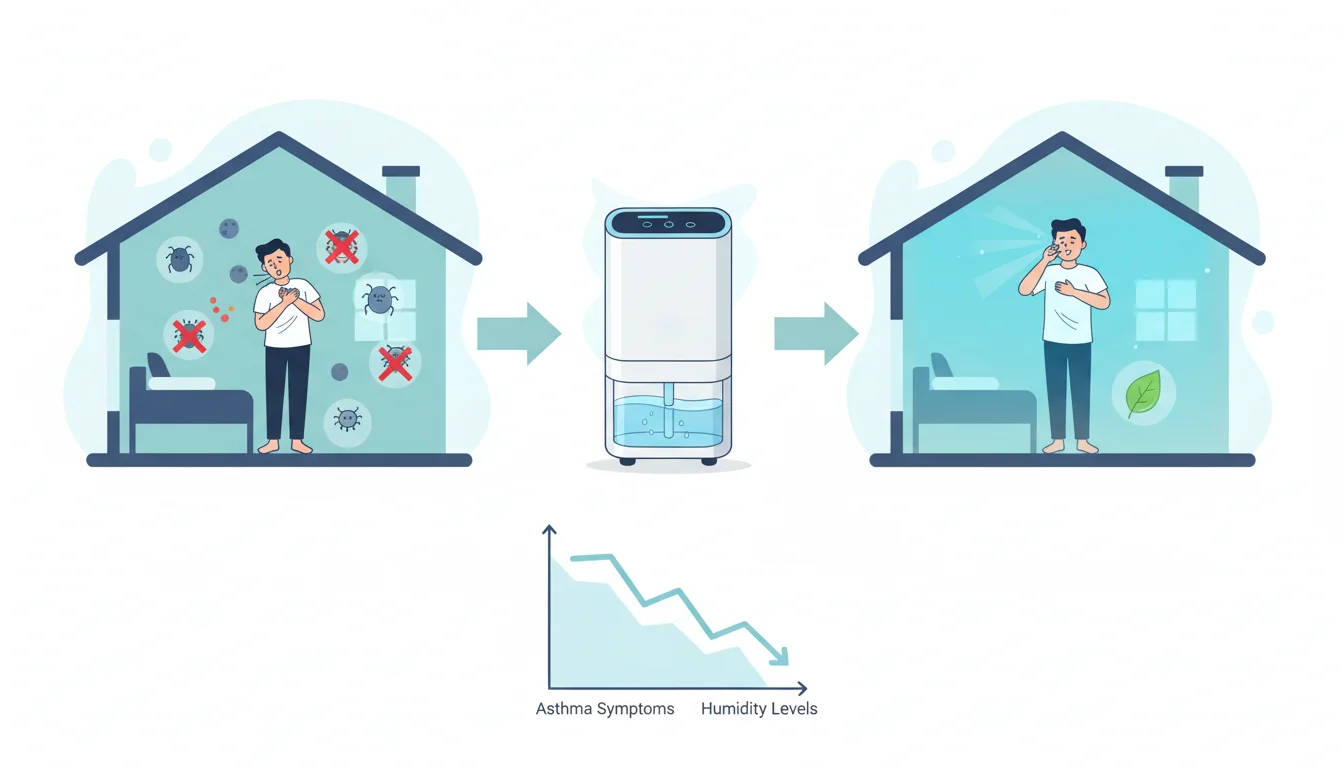
Clinical trials on dehumidifiers show mixed results, with some studies finding limited measurable improvement in lung function despite reduced allergen levels. The gap between patient reports and research findings comes down to study design and individual variation.
Here's what the science actually shows:
- Reducing humidity below 50% significantly decreases dust mite populations
- Mold growth stops when humidity stays below 60%
- Direct airway improvements in controlled studies remain inconsistent
- Symptom relief varies dramatically based on individual triggers
The disconnect makes sense when you consider the details. Clinical studies measure average outcomes across diverse patient groups. Someone whose asthma is triggered primarily by exercise or cold air won't see improvement from humidity control. Someone with severe dust mite allergies might experience dramatic relief.
A [Frontiers in Public Health] study confirmed that poorly ventilated, damp indoor environments increase both asthma risk and symptom severity. The research supports humidity control as part of a comprehensive approach rather than a standalone cure.
When a Dehumidifier Will Help vs. When It Won't
Dehumidifiers provide the most benefit for people whose asthma triggers include mold or dust mites, particularly those living in humid climates or homes with visible moisture problems. They won't help everyone.
A dehumidifier will likely help if you have:
- Confirmed mold or dust mite allergies
- Indoor humidity consistently above 50%
- Visible condensation on windows
- Musty smells in your home
- Symptoms that worsen during humid weather
A dehumidifier probably won't help if your triggers are:
- Pollen or outdoor allergens
- Cold, dry air
- Exercise
- Stress or respiratory infections
- Certain medications
| Your Situation | Recommended Action |
|---|---|
| Humidity >60%, mold allergy | Dehumidifier highly recommended |
| Humidity 50-60%, dust mite allergy | Dehumidifier recommended |
| Humidity <40%, dry air triggers | Consider a humidifier instead |
| Pollen primary trigger | Air purifier more effective |
| Unknown triggers | Get allergy testing first |
Trust me on this: get allergy testing before spending $200 or more on a dehumidifier. An allergist can identify your specific triggers and tell you whether humidity control will actually help. Too many people buy equipment that sits unused because it addressed the wrong problem.
Over-dehumidifying creates its own issues. Dropping humidity below 30% dries out your airways, causing irritation and potentially worsening symptoms. The Asthma and Allergy Foundation emphasizes that balance is everything.
Optimal Humidity Levels and Dehumidifier Usage Tips
Keep indoor humidity between 30% and 50% relative humidity, as recommended by both the EPA and medical professionals specializing in respiratory conditions. A $15 hygrometer tells you exactly where you stand.
Essential setup steps:
- Place the unit in your bedroom first (you spend 8 hours there)
- Position it away from walls for proper airflow
- Set the target humidity to 45% and adjust based on comfort
- Empty the tank before it triggers auto-shutoff
- Clean filters every two weeks
Maintenance prevents problems:
- Wipe down the tank weekly to prevent mold growth inside the unit
- Replace filters according to the manufacturer's schedule
- Check drainage hoses for clogs if using continuous drain
- Inspect coils for dust buildup monthly
Seasonal adjustments matter. Summer in Houston demands aggressive dehumidification. Winter in Denver might require the opposite. Monitor your hygrometer and adjust settings as conditions change.
If your dehumidifier runs constantly but humidity stays high, the unit is undersized for your space. If the air feels uncomfortably dry, reduce the target setting or run it fewer hours per day.
Complementary Solutions for Better Asthma Management
A dehumidifier addresses moisture, but comprehensive asthma management requires tackling multiple fronts simultaneously. Think of it as one tool in your toolbox, not the entire solution.
| Solution | Primary Benefit | Best For |
|---|---|---|
| HEPA air purifier | Removes airborne particles | Pollen, pet dander, dust |
| Dehumidifier | Reduces moisture | Mold, dust mites |
| Exhaust fans | Removes moisture at source | Bathrooms, kitchens |
| Allergen-proof bedding | Blocks dust mites | Bedroom protection |
| Regular vacuuming with HEPA | Removes settled allergens | Floors, upholstery |
Combination units exist but typically compromise on both functions. A dedicated dehumidifier plus a dedicated air purifier outperforms a combo unit at the same price point.
The [American Lung Association] recommends washing bedding weekly in hot water and using allergen-proof mattress covers alongside humidity control. These interventions work together: reducing humidity kills dust mites, but you still need to remove the allergens they left behind.
FAQ
How long does it take for a dehumidifier to help asthma symptoms?
Most people notice improvement within 2-4 weeks of consistent use. Dust mite populations decline after humidity drops below 50% for several days. Mold spores take longer to clear from your environment.
Should I run my dehumidifier all day?
Run it during hours when humidity peaks—typically afternoons in summer. Continuous operation wastes energy if humidity stays within your target range. A unit with a built-in humidistat cycles automatically.
What humidity level is too low for asthma?
Humidity below 30% dries out airways and increases irritation. This causes coughing, scratchy throat, and can potentially worsen asthma symptoms. Target 40-45% for optimal comfort and trigger reduction.
Do I need a dehumidifier if I have central air conditioning?
Air conditioning removes some moisture but often not enough in humid climates. Check your indoor humidity with a hygrometer. If readings consistently exceed 50%, add a dehumidifier.
Where should I place a dehumidifier for asthma relief?
Start with your bedroom since you spend the most time there. Basements are secondary priorities due to natural dampness. Place units away from walls with at least 12 inches of clearance for airflow.
Is a dehumidifier or air purifier better for asthma?
They serve different purposes. Dehumidifiers reduce mold and dust mites by controlling moisture. Air purifiers remove airborne particles. Most asthma sufferers benefit from both working together.
How often should I clean my dehumidifier?
Empty and wipe the water tank every 2-3 days. Clean filters every two weeks. Deep clean the entire unit monthly. Neglected dehumidifiers can grow mold inside and actually worsen air quality.
Will a dehumidifier help with nighttime asthma symptoms?
If humidity in your bedroom exceeds 50% and you have mold or dust mite triggers, yes. Place the unit in your bedroom and run it for several hours before sleep. Monitor your symptoms over 2-3 weeks to gauge effectiveness.
Share this post
Related Articles
Best Dehumidifier for RV: Complete Buyer's Guide for 2026
Best Dehumidifier for RV: Complete Buyer's Guide for 2026
Will a Dehumidifier Get Rid of Silverfish? Complete Guide to Humidity-Based Pest Control
Will a Dehumidifier Get Rid of Silverfish? Complete Guide to Humidity-Based Pest Control
Will a Dehumidifier Dry Out Damp Walls? Complete Guide to Wall Moisture Removal
Will a Dehumidifier Dry Out Damp Walls? Complete Guide to Wall Moisture Removal