Best Dehumidifier for Crawl Space: Complete Buying Guide 2026
Best Dehumidifier for Crawl Space: Complete Buying Guide 2026
A dehumidifier for crawl space removes moisture from enclosed areas beneath your home, preventing wood rot, mold growth, and structural damage. Crawl spaces contribute up to 50% of indoor air pollutants on the first floor, making moisture control essential for both home integrity and respiratory health. This guide covers sizing, top models, installation options, and operating costs for 2026.
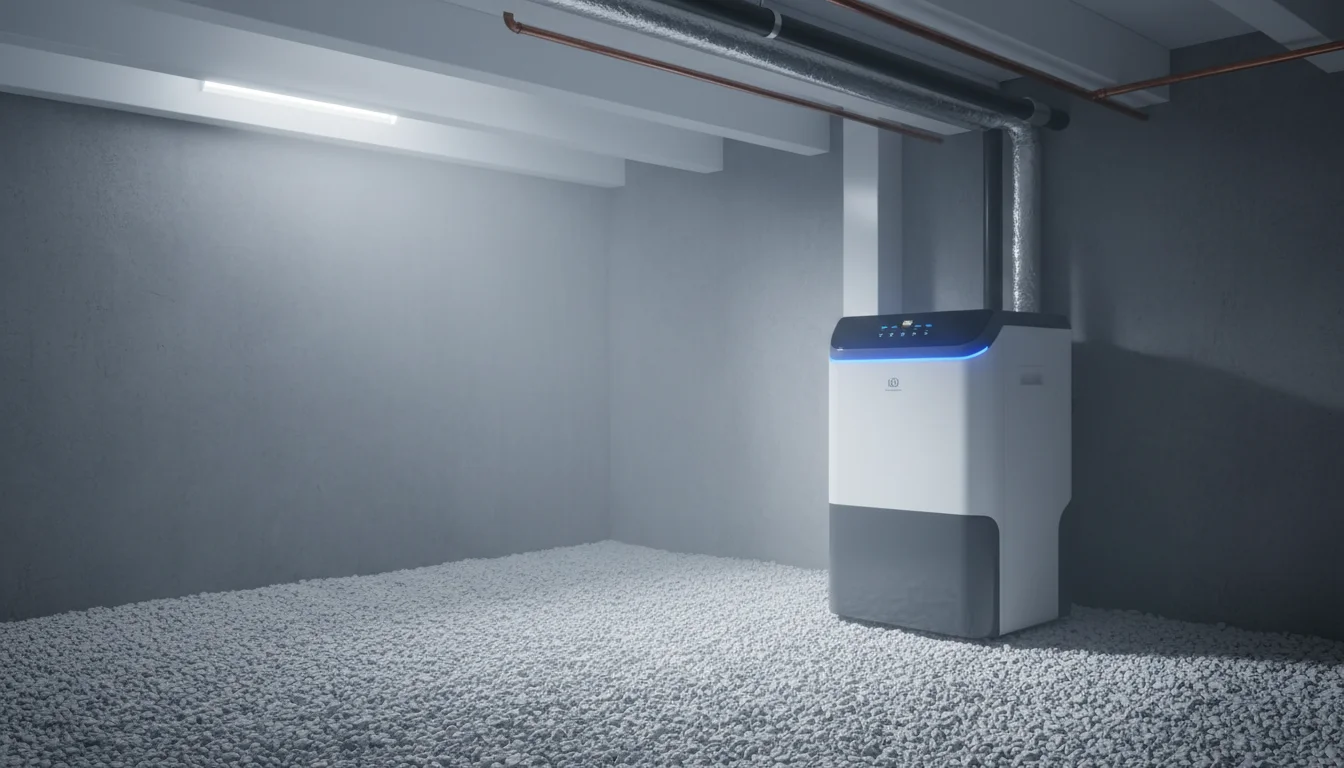
Why Your Crawl Space Needs a Dehumidifier
Excess crawl space moisture triggers a cascade of problems that affect your entire home. Without intervention, humidity levels above 60% create ideal conditions for mold colonies, wood-destroying fungi, and pest infestations that spread upward into living spaces.
Signs you have a moisture problem:
- Musty odors rising through floor vents or registers
- Visible mold on floor joists or subflooring
- Condensation forming on pipes and ductwork
- Soft or spongy spots in flooring above the crawl space
- Increased allergy symptoms among household members
The health risks extend beyond structural concerns. Mold spores and dust mites thrive in damp environments, and these allergens enter your HVAC system and circulate throughout your home. Controlling crawl space humidity reduces allergy symptoms by limiting the dust mite populations that need moisture to survive.
Standard household dehumidifiers fail in crawl spaces for several reasons. They lack the corrosion-resistant housing needed for harsh environments, and most stop working below 65°F. Crawl space units feature hot-gas defrost systems, commercial-grade compressors, and gravity drain connections that household models lack.
The investment protects your floor joists, subflooring, and foundation from deterioration. Wood rot repairs cost thousands of dollars, while a quality dehumidifier costs a fraction of that and prevents damage before it starts. [VanCo Crawl Space] notes that proper crawl space dehumidification allows insulation to perform better, improving overall energy efficiency.
How to Size a Crawl Space Dehumidifier: PPD Ratings Explained
PPD stands for pints per day, measuring how much moisture a unit removes in 24 hours under standardized test conditions at 65°F. Your crawl space size, current humidity levels, and regional climate determine the capacity you need.
Sizing formula basics:
- Calculate square footage (length × width)
- Assess moisture severity (damp, wet, or standing water)
- Add 20-30% capacity for coastal or high-humidity climates
- Consider ceiling height for total volume calculation
| Crawl Space Size | Recommended PPD | Best For |
|---|---|---|
| 500-800 sq. ft. | 50-70 PPD | Small homes, dry climates |
| 800-1,200 sq. ft. | 70-90 PPD | Average residential spaces |
| 1,200-1,600 sq. ft. | 90-120 PPD | Larger homes, moderate moisture |
| 1,600-2,300 sq. ft. | 145-200 PPD | Commercial-grade needs |
Most residential crawl spaces fall into the 70-90 PPD range. Round up if you live in a coastal area, have poor drainage, or notice persistent dampness. Undersized units run constantly without controlling humidity, while oversized units dry faster but cycle more frequently.
Commercial-grade units become necessary when your space exceeds 1,000 square feet with severe moisture issues. These models operate effectively down to 40°F, feature self-draining capabilities, and include MERV-8 filtration. [Bob Vila] recommends professional load calculations for challenging installations to ensure proper sizing.
Top Crawl Space Dehumidifier Models for 2026
The best crawl space dehumidifiers balance moisture removal capacity with energy efficiency, durability, and features suited for harsh environments. Five models stand out for residential applications this year.
| Model | PPD Rating | Coverage | Noise Level | Warranty | Best For |
|---|---|---|---|---|---|
| Santa Fe Compact 70 | 70 PPD | 1,200 sq. ft. | 49 dBA | 5 years | Overall reliability |
| Mega Dry CS | 145-160 PPD | 2,300 sq. ft. | 50-53 dBA | 5 years | High-moisture spaces |
| Aprilaire E70 | 70 PPD | 2,200 sq. ft. | 53 dBA | 5 years | Smart features |
| Aprilaire E80 | 80 PPD | 2,200 sq. ft. | 45 dBA | 5 years | Quiet operation |
| AlorAir HD55S | 55 PPD | 1,300 sq. ft. | 50 dBA | 5 years | Budget-friendly |
Santa Fe Compact 70 earns its reputation as the industry standard. The 16.5-inch height fits tight crawl spaces, while MERV-13 filtration improves air quality beyond moisture control. Hot-gas defrost keeps it running in cold conditions where other units shut down.
Mega Dry crawl space dehumidifier handles the toughest jobs. Heavy-duty metal housing survives flood-prone environments, and the built-in condensate pump eliminates drainage headaches. This is the ideal choice for any space with persistent water intrusion or extreme humidity.
Aprilaire E70 and E80 bring smart home integration to crawl spaces. Wi-Fi monitoring lets you check humidity levels without crawling underneath your house. The E80 runs at 45 dBA, making it the quietest option. Keep in mind that the smart features require a stable WiFi signal in your crawl space.
For smaller spaces under 1,000 square feet, the AlorAir HD55S delivers solid performance at a lower price point. ENERGY STAR certification keeps operating costs reasonable. TheDryAir rates it among the best budget options for 2026.
Installation: DIY vs Professional Setup
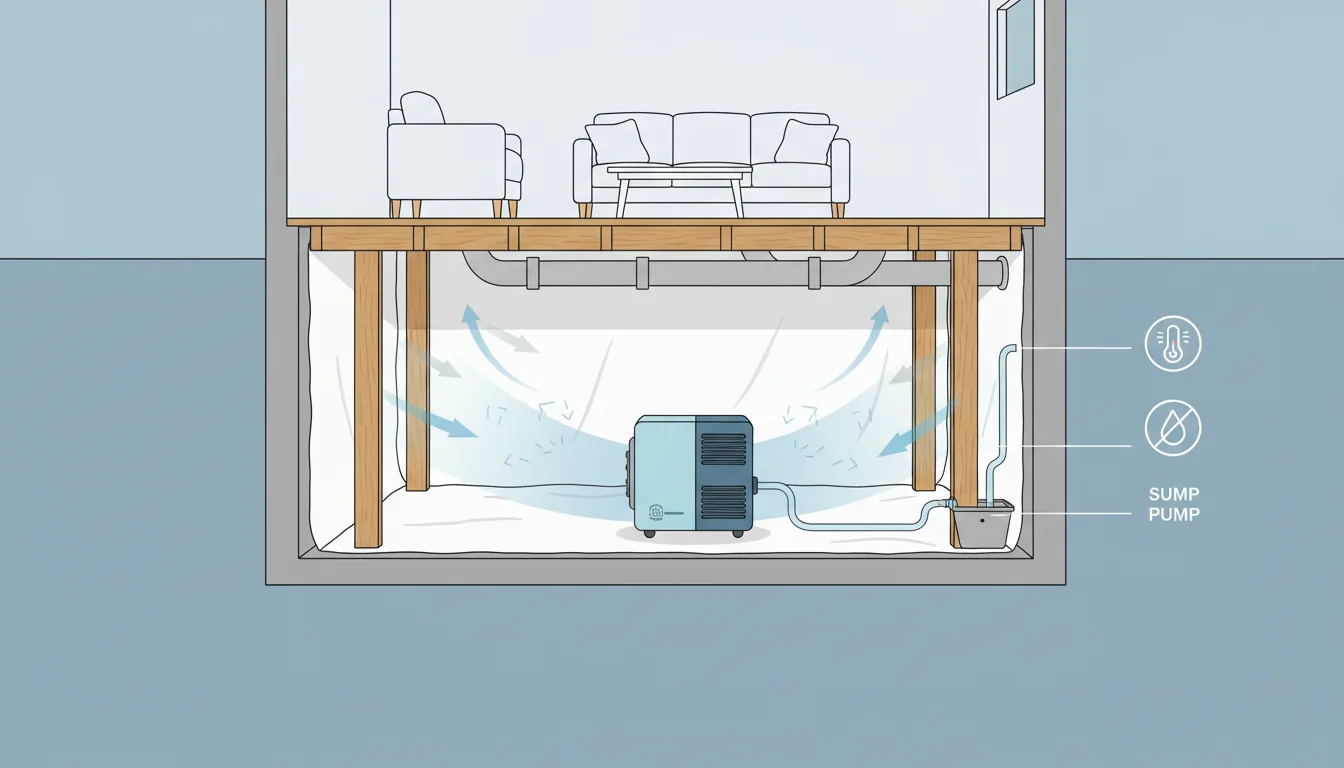
Proper installation requires drainage routing, electrical access, and strategic placement for optimal air circulation. Handy homeowners with basic electrical knowledge can handle most installations in 4-6 hours.
DIY installation checklist:
- GFCI-protected electrical outlet within cord reach
- Drainage solution (gravity drain to exterior or condensate pump)
- Level mounting surface (concrete blocks or platform)
- Adequate clearance for airflow (12 inches on all sides)
- Vapor barrier beneath unit if crawl space has dirt floor
Crawl space dehumidifier with pump options simplify drainage. Gravity drains work when your crawl space sits above grade with an exterior exit point. Condensate pumps push water uphill to drains or exterior discharge points. Most quality units include pump connections or built-in pumps.
| Installation Type | Cost Range | Time Required | Best For |
|---|---|---|---|
| DIY Basic | $800-1,200 | 4-6 hours | Simple spaces, existing outlet |
| DIY with Encapsulation | $1,200-2,000 | 1-2 days | Handy homeowners |
| Professional Basic | $1,500-2,500 | Half day | Tight spaces, electrical work |
| Professional with Encapsulation | $2,500-7,000+ | 1-3 days | Complete moisture solution |
Professional installation makes sense when combining your dehumidifier with crawl space encapsulation. Vapor barriers, sealed vents, and proper drainage work together as a system. Professionals also handle electrical upgrades if your crawl space lacks proper outlets.
The average crawl space dehumidifier installation cost runs around $7,000 when including full encapsulation. Angi reports ranges from $1,500 to $14,000 depending on space size and complexity. Encapsulation combined with dehumidification reduces heating and cooling costs by approximately 15% through improved temperature stability.
Operating Costs and Energy Efficiency
Running a crawl space dehumidifier costs $15-40 monthly depending on your climate, unit efficiency, and target humidity level. Most units draw 500-800 watts during operation, comparable to a small window air conditioner.
Factors affecting operating costs:
- Local electricity rates (national average: $0.16/kWh)
- Regional humidity levels and seasonal variation
- Target humidity setting (45-50% optimal for most climates)
- Unit energy efficiency rating
- Crawl space encapsulation status
| Operating Scenario | Monthly Cost | Annual Cost |
|---|---|---|
| Dry climate, efficient unit | $15-20 | $180-240 |
| Moderate humidity | $25-30 | $300-360 |
| High humidity, older unit | $35-45 | $420-540 |
| Encapsulated space | 15-20% less | Varies |
ENERGY STAR certified models use 15-20% less electricity than standard units. Both the Santa Fe Compact 70 and AlorAir HD55S carry this certification. Over a 10-year lifespan, efficient models save $300-600 in electricity costs.
Set your target humidity between 45-50% for optimal efficiency. Lower settings force the unit to run longer without meaningful benefit, while higher settings risk allowing mold growth. Smart units with humidity sensors cycle appropriately rather than running continuously.
The ROI calculation favors dehumidifier investment heavily. Wood rot repairs average $1,000-5,000. Mold remediation runs $2,000-6,000 for crawl spaces. Foundation repairs cost $5,000-15,000. A $1,500 dehumidifier that prevents any of these problems pays for itself immediately.
Maintenance Tips for Longevity
Quality crawl space dehumidifiers last 8-12 years with basic maintenance performed quarterly. Neglected units fail in 3-5 years and consume more electricity as efficiency drops.
Essential maintenance schedule:
- Monthly: Check filter condition, clean if dusty
- Quarterly: Inspect drainage lines for clogs, verify pump operation
- Biannually: Clean coils with soft brush or vacuum
- Annually: Professional inspection if accessible, full system check
Filter cleaning takes five minutes and prevents most efficiency problems. Dirty filters restrict airflow, forcing the compressor to work harder. MERV-13 filters capture smaller particles but clog faster in dusty crawl spaces, so keep spare filters on hand.
Coil maintenance matters for units in dirty environments. Dust accumulation on evaporator coils reduces heat transfer efficiency. A soft brush or shop vacuum attachment removes buildup without damaging fins. Never use water on coils while the unit is operating.
Drainage system failures cause the most service calls. Condensate pumps have float switches that can stick or fail, and gravity drain lines develop algae buildup that restricts flow. Flush drain lines with diluted bleach solution twice yearly to prevent clogs.
The 30 minutes per quarter you spend on maintenance prevents expensive service calls. I learned this lesson after ignoring a clogged drain line that triggered a float switch shutdown during a humid August week. The resulting mold remediation cost more than five years of maintenance would have.
FAQ
What humidity level should I set my crawl space dehumidifier to?
Set your target between 45-50% relative humidity. This range prevents mold growth while avoiding excessive energy consumption. Lower settings provide minimal additional benefit and increase operating costs significantly.
Can I use a regular dehumidifier in my crawl space?
Standard household dehumidifiers lack the durability, low-temperature operation, and drainage options that crawl spaces require. They typically fail within 1-2 years in harsh crawl space conditions and stop working below 65°F—precisely when moisture problems often worsen.
How long does a crawl space dehumidifier run each day?
In humid climates, expect 12-18 hours of daily operation during summer months. Winter operation drops to 4-8 hours in most regions. Encapsulated crawl spaces require less runtime due to reduced moisture intrusion.
Do I need encapsulation with my crawl space dehumidifier?
Encapsulation dramatically improves dehumidifier effectiveness by reducing moisture entry points. While not required, combining both reduces dehumidifier runtime by 30-40% and provides comprehensive moisture control that dehumidification alone cannot achieve.
What size electrical circuit does a crawl space dehumidifier need?
Most residential units require a dedicated 15-amp, 120-volt circuit with GFCI protection. Commercial-grade units over 100 PPD may need 20-amp circuits. Verify requirements in your specific model's specifications before installation.
How do I drain my crawl space dehumidifier?
Three options exist: gravity drain to exterior (simplest if grade allows), condensate pump to drain or exterior, or manual bucket emptying (not recommended for crawl spaces). Most quality units include pump connections for flexible drainage routing.
When should I replace my crawl space dehumidifier?
Replace units showing decreased moisture removal despite clean filters, unusual noises from the compressor or fan, refrigerant leaks, or control board failures. Units over 10 years old often lack efficiency compared to newer models, making replacement cost-effective even if still functional.
Share this post
Related Articles
Would a Dehumidifier Help With Asthma? What Science Says in 2026
Would a Dehumidifier Help With Asthma? What Science Says in 2026
Best Dehumidifier for RV: Complete Buyer's Guide for 2026
Best Dehumidifier for RV: Complete Buyer's Guide for 2026
Will a Dehumidifier Get Rid of Silverfish? Complete Guide to Humidity-Based Pest Control
Will a Dehumidifier Get Rid of Silverfish? Complete Guide to Humidity-Based Pest Control