Dehumidifier Inside Grow Tent: Complete Placement Guide for 2026
Dehumidifier Inside Grow Tent: Complete Placement Guide for 2026
Humidity control determines whether your indoor grow succeeds or falls victim to mold and mildew. A dehumidifier inside grow tent setups can add 3-10°F of heat, while outside placement eliminates counterproductive cycling with exhaust fans. This guide covers optimal placement strategies based on your tent size, ventilation setup, and growth stage requirements.
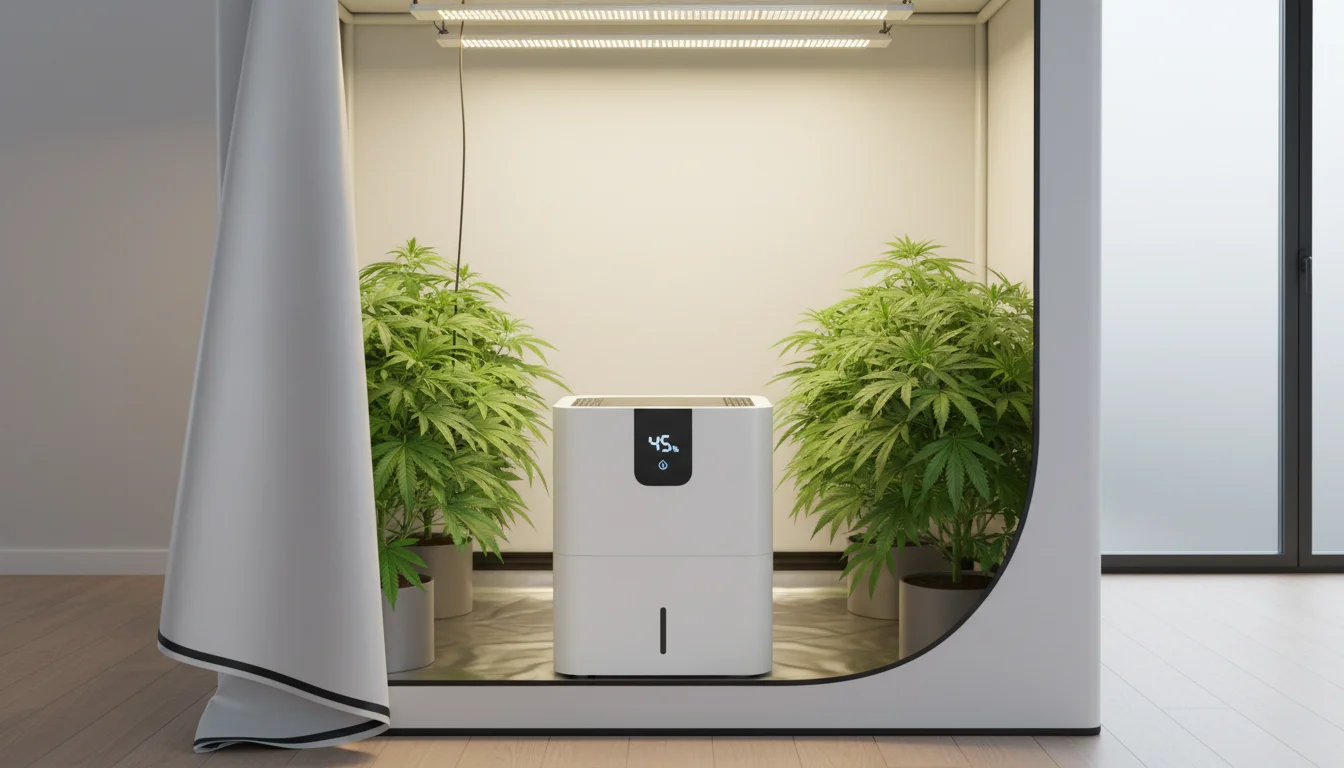
Inside vs Outside Tent Placement: Which Is Better?
The answer depends entirely on whether you run exhaust fans. Inside placement gives you direct control over your microclimate with faster response times. Outside placement in a lung room prevents your dehumidifier from running continuously against incoming humid air.
| Factor | Inside Tent | Outside (Lung Room) |
|---|---|---|
| Heat Impact | Adds 3-10°F to tent | Heat stays outside tent |
| Best For | Large tents 8x8+, no exhaust | Small tents 4x4 and under |
| Energy Use | Higher if exhaust runs | Lower overall consumption |
| Space Required | Takes grow space | Needs adjacent room |
| Humidity Control | Direct, precise | Requires proper ductwork |
| Maintenance Access | Harder, disturbs plants | Easy, no plant contact |
If your exhaust fan pulls air out while your dehumidifier removes moisture inside, you create an endless cycle. The unit never shuts off because fresh humid air constantly replaces what it just processed. Outside placement solves this by conditioning air before it enters your tent.
For tents under 4x4, the heat and space trade-offs favor outside placement. Larger grows with 8x8 tents or dedicated rooms handle internal units better because the volume absorbs heat and provides room for proper airflow. [AloAir Crawlspace] reports this outside configuration as "the most efficient way to run the dehumidifier."
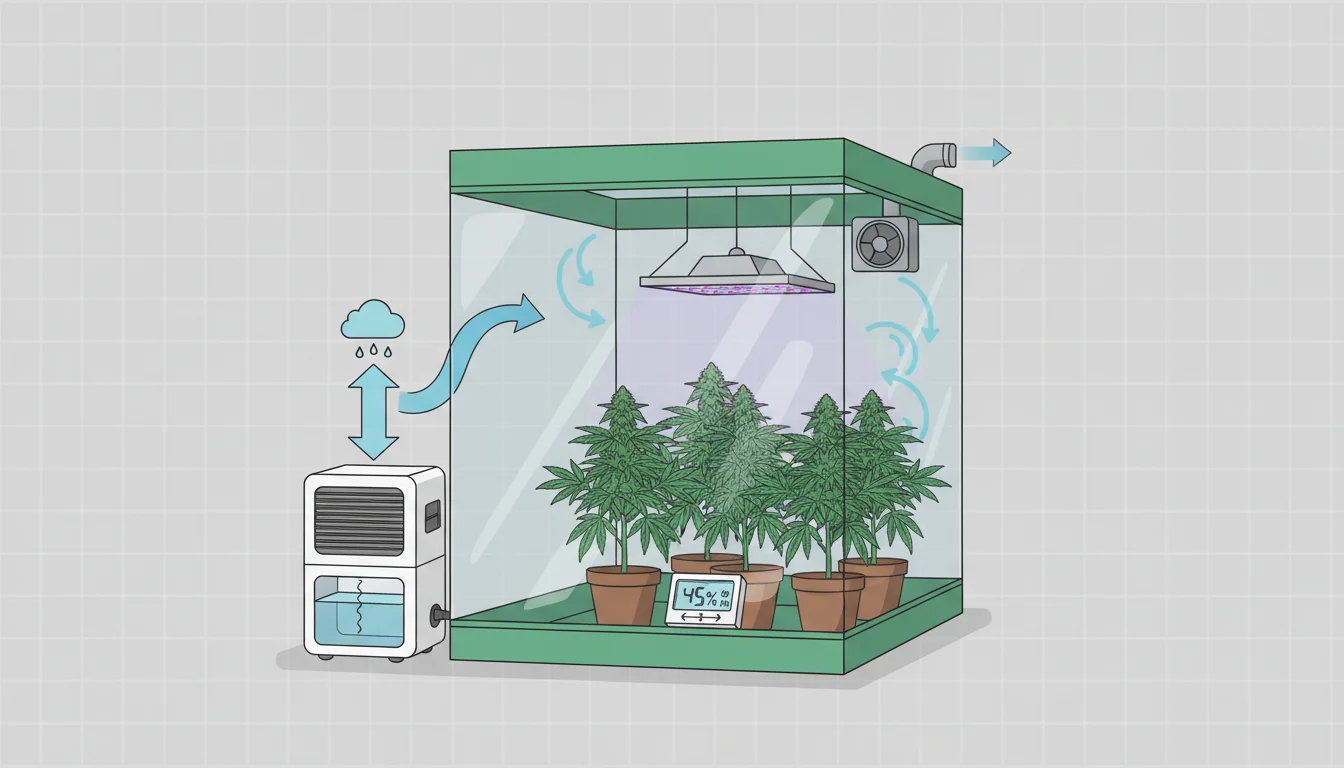
Managing Temperature Rise from Internal Dehumidifiers
Compressor-based dehumidifiers generate heat as a byproduct of condensation. Expect temperature increases of 3-10°F depending on unit size and tent volume. This heat becomes problematic during flowering when you need cooler temperatures for terpene preservation.
Strategies to control heat buildup:
- Position the unit near your intake vent so warm exhaust air gets pulled out faster
- Increase exhaust fan speed to compensate for the added heat load
- Run the dehumidifier during lights-off when ambient temps drop
- Choose desiccant models over compressor types for lower heat output
- Integrate with AC systems to offset the temperature rise
Scheduling matters more than most growers realize. Running your dehumidifier during dark periods takes advantage of naturally lower temperatures. Your plants still transpire at night, so humidity control remains necessary—and the darkness period is when bud rot risk peaks anyway.
Desiccant dehumidifiers use a different technology that generates less heat per pint of water removed. They cost more upfront but perform better in cooler environments where compressor models ice up.
Lung Room Setup for Optimal Humidity Control
A lung room is the adjacent space where your climate equipment operates, feeding conditioned air into your sealed tent. This configuration keeps equipment outside, reduces internal temperatures, and simplifies maintenance without disturbing your canopy.
Essential lung room components:
- Sealed grow tent with dedicated intake from the conditioned lung room
- Dehumidifier sized for the combined lung room and tent volume
- Proper ductwork connecting lung room air supply to tent intake
- Negative pressure in tent relative to lung room
- Continuous drainage system for collected water
One grower on [Gorilla Grow Tent] reported maintaining lung room humidity at 45% while their tent ran only 15% higher without any internal dehumidifier. The setup works "like a charm" for rapid humidity reduction.
The initial cost runs higher due to ductwork, a larger dehumidifier, and proper sealing materials. However, serious growers recover this investment through better results, lower energy bills, and equipment that lasts longer outside the harsh tent environment. Your dehumidifier stays cleaner and more accessible for filter changes.
Sizing Your Dehumidifier for Grow Tent Dimensions
Calculate your tent's cubic footage first by multiplying length, width, and height in feet. A 4x4x6 tent equals 96 cubic feet. Then factor in plant count and growth stage, because flowering plants transpire significantly more moisture than vegetative plants.
| Tent Size | Cubic Feet | Recommended Capacity | Flowering Adjustment |
|---|---|---|---|
| 2x2x5 | 20 | 10-15 pints/day | +20% capacity |
| 4x4x6 | 96 | 20-30 pints/day | +30% capacity |
| 5x5x7 | 175 | 35-45 pints/day | +30% capacity |
| 8x8x7 | 448 | 50-70 pints/day | +40% capacity |
Always size up from minimum calculations. Peak humidity periods during heavy flowering push moisture loads beyond baseline estimates. Running a unit at 80% capacity extends its lifespan compared to one constantly maxed out.
Energy efficiency ratings matter because these units run continuously for months. A dehumidifier with better efficiency saves considerable electricity costs over a full grow cycle. CoAiro recommends considering multiple smaller units for larger spaces. This approach provides redundancy if one fails and enables zoned humidity control.
VPD Optimization and Growth Stage Humidity Requirements
VPD measures the difference between how much moisture air holds versus how much it could hold at saturation. This metric matters more than relative humidity alone because it accounts for temperature. Optimal VPD keeps stomata open for CO2 absorption and nutrient transport.
| Growth Stage | Target RH | Target VPD | Why It Matters |
|---|---|---|---|
| Seedling/Clone | 65-70% | 0.4-0.8 kPa | Prevents desiccation of fragile roots |
| Vegetative | 50-60% | 0.8-1.2 kPa | Maximizes leaf expansion and growth |
| Early Flowering | 45-55% | 1.0-1.4 kPa | Balances growth with mold prevention |
| Late Flowering | 35-45% | 1.2-1.5 kPa | Prevents bud rot, preserves terpenes |
Late flowering demands the lowest humidity. Dense flower structures trap moisture and create microenvironments where botrytis thrives. Dropping below 45% RH during the final weeks protects your harvest investment.
Smart controllers automate these transitions based on growth stage programming. Manual adjustments work but require consistent attention. A $200 controller pays for itself by preventing just one mold outbreak.
Troubleshooting Common Humidity Problems
When humidity refuses to drop despite running your dehumidifier, the issue usually traces back to air leaks, undersized equipment, or overwatering. Systematic troubleshooting identifies the actual cause.
Humidity won't decrease:
- Check all tent seams, zipper tracks, and duct connections for air leaks
- Verify your dehumidifier capacity matches tent volume calculations
- Reduce watering frequency and volume per plant
- Inspect the unit's filter for blockages reducing airflow
Fluctuating humidity levels:
- Add oscillating fans to break up humidity pockets
- Ensure tent seals remain intact during entry and exit
- Check dehumidifier placement for optimal air circulation
- Verify hygrometer accuracy with a second meter
Dehumidifier icing up:
Compressor models ice over when ambient temperatures drop below 65°F. Use a unit with auto-defrost or switch to a desiccant model for cooler environments. Raising your lung room temperature above 65°F prevents this issue entirely.
Condensation on tent walls signals temperature differential problems. Warm humid air hitting cooler surfaces creates water droplets. Increase air circulation and narrow the gap between canopy temperature and tent wall temperature.
FAQ
How often should I empty my grow tent dehumidifier?
Units in flowering tents collect 1-3 gallons daily depending on plant count. Install a continuous drain line to a floor drain or collection bucket with overflow protection. Manual emptying twice daily works for smaller operations.
Do mini dehumidifiers work for grow tents?
Mini dehumidifiers remove 8-16 ounces per day. This capacity handles 2x2 tents with 1-2 small plants in vegetative stage. Flowering plants or larger tents overwhelm these units completely. They work as supplements, not primary humidity control.
Should I run my dehumidifier 24/7?
During flowering, continuous operation prevents nighttime humidity spikes when temperatures drop and relative humidity climbs. Use a hygrometer with logging to determine your specific needs. Some setups maintain targets with 16-18 hours of daily runtime.
What humidity level causes bud rot?
Botrytis spores germinate when relative humidity exceeds 55% combined with temperatures between 60-75°F. Dense flower structures create microclimates 10-15% more humid than ambient readings. Keep tent RH at 45% or lower during late flowering.
Can I use a household dehumidifier in my grow tent?
Standard household dehumidifiers work in lung room setups where heat output stays outside the tent. Inside placement adds excessive heat, and these units lack features like continuous drainage or low-temperature operation found in grow-specific models.
How do I know if my dehumidifier is undersized?
If your unit runs continuously without reaching target humidity, it lacks capacity for your space. Check that filters are clean first. A properly sized dehumidifier cycles on and off as needed rather than operating non-stop.
Does dehumidifier placement affect electricity costs?
Outside placement typically reduces energy consumption by 20-30% compared to fighting against exhaust fans inside the tent. The dehumidifier processes air once before it enters rather than competing with constant fresh air replacement.
When should I increase dehumidification during flowering?
Boost capacity or runtime when flower sites begin forming dense structures around week 3-4 of flowering. This transition period sees transpiration rates increase 30-50% as plants push moisture through developing buds.
Share this post
Related Articles
Would a Dehumidifier Help With Asthma? What Science Says in 2026
Would a Dehumidifier Help With Asthma? What Science Says in 2026
Best Dehumidifier for RV: Complete Buyer's Guide for 2026
Best Dehumidifier for RV: Complete Buyer's Guide for 2026
Will a Dehumidifier Get Rid of Silverfish? Complete Guide to Humidity-Based Pest Control
Will a Dehumidifier Get Rid of Silverfish? Complete Guide to Humidity-Based Pest Control