Dehumidifier on Top or Bottom Floor? The Complete Placement Guide for 2026
Dehumidifier on Top or Bottom Floor? The Complete Placement Guide for 2026
Deciding whether to place a dehumidifier on top or bottom floor depends on where moisture originates in your home. Basements and ground floors account for over 98% of moisture infiltration through ground contact and air gaps. This guide covers the physics of humidity movement, optimal placement strategies, and seasonal adjustments for maximum efficiency.
Understanding How Humidity Moves Between Floors
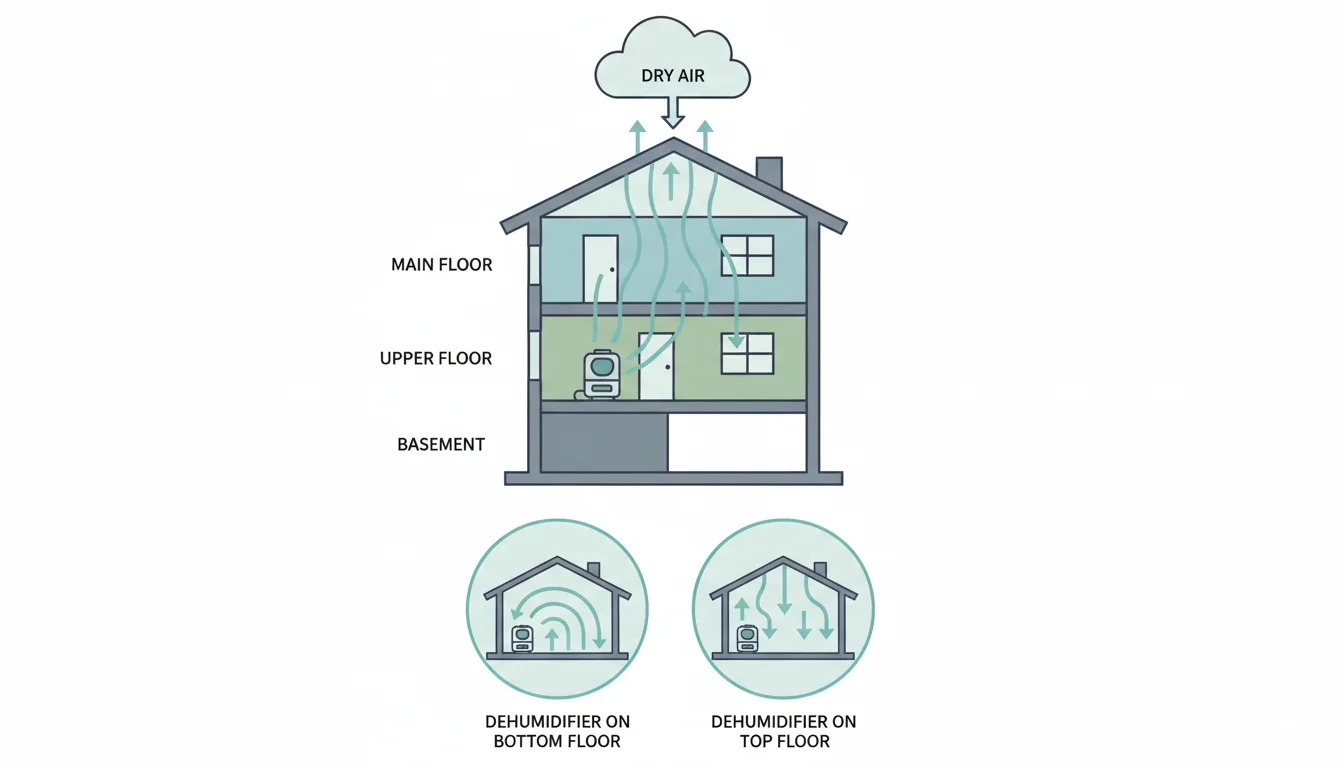
Warm moist air rises while cool dry air sinks, creating natural humidity circulation throughout multi-story homes. This convection process carries moisture-laden air upward while denser cool air settles at lower levels.
Basements and ground floors typically hold more moisture for a simple reason: ground contact. Concrete slabs absorb water through capillary action, pulling moisture upward through tiny pores. Poor vapor barriers under foundations allow this moisture to penetrate continuously.
The stack effect amplifies this problem. Warm indoor air rises and escapes through upper openings, drawing cooler outdoor air in through lower gaps. During summer months, upper floors accumulate heat, enabling air to hold more moisture and creating humidity problems that your HVAC system struggles to control.
| Season | Primary Humidity Source | Most Affected Floor |
|---|---|---|
| Spring/Summer | Ground moisture + rain | Basement/Ground floor |
| Summer Peak | Heat accumulation | Upper floors |
| Fall/Winter | Condensation | Varies by insulation |
Understanding this movement pattern helps you target the right floor. Start by measuring humidity on each level with a hygrometer before deciding on placement.
When to Place Your Dehumidifier on the Bottom Floor
Ground-level placement works best for most homes because basements and ground floors generate the majority of indoor moisture. Treating humidity at its source prevents moisture from traveling upward through your entire home.
Why bottom floors need attention:
- Direct earth contact creates constant moisture infiltration
- Poor ventilation traps humid air in enclosed spaces
- Concrete slabs release absorbed groundwater continuously
- Crawl spaces lack adequate air circulation
- Finished basements trap moisture behind walls
Target humidity between 30-50% in basement spaces. Anything above 50% creates ideal conditions for mold growth and structural damage.
Homes with finished basements benefit most from this approach. I learned this after dealing with musty odors that kept returning despite cleaning. The moisture source was underground, not in the living space. Once the basement dehumidifier brought levels down to 45%, the smell disappeared within days.
Place the unit on a waterproof platform if your basement floor tends to collect condensation. Plan for drainage using a condensate pump to avoid emptying the tank manually. According to [Homes & Gardens], central basement placement allows maximum air circulation and prevents humid pockets that promote mold growth.
When to Place Your Dehumidifier on the Top Floor
Upper floor placement becomes necessary when heat accumulation creates humidity problems that basement treatment cannot solve. Summer months bring specific challenges as hot attic air radiates downward into living spaces.
Signs you need upper floor placement:
- Condensation appearing primarily on upper-floor windows
- Bathrooms or laundry rooms located on upper levels
- Poor attic insulation allowing heat transfer
- Sticky, uncomfortable bedrooms despite running AC
- Visible mold near ceiling corners upstairs
Climate zone matters significantly here. Homes in humid regions like the Gulf Coast or Pacific Northwest often need upper floor focus year-round. Constant moisture in outdoor air combines with indoor heat to create persistent humidity problems.
Fair warning: upper floor placement requires monitoring basement levels separately. You might solve the upstairs problem while creating a new one below. [Consumer Reports] recommends checking each floor with a hygrometer weekly until you establish stable humidity patterns.
Optimal Height and Room Positioning
Position your dehumidifier 12-18 inches off the ground and 6-12 inches from walls for optimal air intake and circulation. Because humid air settles near floor level, slight elevation proves essential for efficient moisture removal.
| Positioning Factor | Optimal Range | Why It Matters |
|---|---|---|
| Height off ground | 12-18 inches | Captures settling humid air |
| Wall clearance | 6-12 inches | Allows proper airflow |
| Furniture distance | 12+ inches | Prevents vent obstruction |
| Room position | Center | Even air distribution |
Central room placement allows dry air to distribute evenly throughout the space. This matters most in larger rooms or open-concept areas where corners trap stagnant humid air.
Landing and hallway positioning can serve multiple rooms effectively. According to Meaco Blog, keeping internal doors open lets moisture migrate toward the dehumidifier's dry zone.
Avoid heat sources, open windows, and dusty areas. Heat sources force the unit to work overtime. Open windows introduce continuous outdoor moisture. Dusty areas clog filters and reduce efficiency within weeks.
Single Dehumidifier vs Multiple Units: What Works Best
A single unit handles most homes effectively when placed on the floor with the worst humidity problem. Multiple dehumidifiers become necessary for homes over 2,500 square feet or those with severe moisture issues on multiple levels.
Single unit strategy:
- Identify the floor with highest humidity readings
- Place the unit centrally with proper clearance
- Keep interior doors open to allow airflow between floors
- Run ceiling fans to promote air circulation
- Monitor other floors weekly
When to add a second unit:
- Basement and upper floor both exceed 55% humidity
- Single unit runs continuously without reaching target
- Home square footage exceeds 2,500 sq ft
- Multiple moisture sources exist on different levels
The cost-benefit calculation favors a single properly-placed unit for most homeowners. Running two 500-watt dehumidifiers costs roughly $15-20 more per month than one unit. That expense makes sense only when a single unit cannot control your moisture problem.
Whole-home dehumidifier integration with HVAC offers an alternative solution. These systems cost $1,500-3,000 installed but eliminate portable unit management entirely. They work best in new construction or during HVAC replacement.
Seasonal Placement Adjustments for Year-Round Control
Spring and summer demand basement focus as increased rainfall and ground moisture create peak humidity conditions below ground level. Fall and winter shift attention upward when condensation forms on cold windows and exterior walls.
Seasonal adjustment schedule:
- March-May: Move unit to basement, target 45% humidity
- June-August: Monitor upper floors, relocate if readings exceed 55%
- September-November: Check for window condensation upstairs
- December-February: Focus on areas with visible moisture issues
A hygrometer on each floor transforms guesswork into data-driven decisions. Digital models cost $10-15 and provide readings within 3% accuracy. Check levels at the same time daily for consistent comparison.
I keep a simple spreadsheet tracking humidity by floor and date. After three months, clear patterns emerge. My basement needs the dehumidifier from April through September. Upper floors only exceed 50% during July heat waves. Your home will show different patterns based on construction, insulation, and local climate.
FAQ
Does a dehumidifier work better upstairs or downstairs?
Downstairs placement works better for most homes because ground floors generate the majority of indoor moisture through earth contact. Upper floor placement makes sense only when heat accumulation or specific moisture sources create problems above ground level.
How do I know if my basement needs a dehumidifier?
Readings above 50% humidity indicate a need for dehumidification. Other signs include musty odors, visible condensation on pipes, water stains on walls, and mold growth in corners. A hygrometer provides definitive measurements.
Should I run my dehumidifier 24/7?
Continuous operation works best until humidity reaches your target range of 30-50%. Most units include a humidistat that cycles the compressor on and off automatically. Running constantly for the first 24-48 hours helps establish baseline control.
Will one dehumidifier work for my whole house?
One properly-placed unit handles homes under 2,500 square feet with moderate humidity issues. Keep interior doors open and use ceiling fans to promote airflow between floors. Homes with severe moisture problems or larger square footage need multiple units.
What size dehumidifier do I need for a basement?
A 50-pint capacity unit handles most basements up to 2,000 square feet with moderate dampness. Extremely wet basements or spaces over 2,000 square feet need 70-pint models. Undersized units run constantly without reaching target humidity.
Can I put a dehumidifier in a closet?
Closet placement restricts airflow and reduces efficiency significantly. The unit needs open space to draw in humid air and expel dry air. Place it in the main room and keep closet doors open to allow moisture migration.
How far should a dehumidifier be from the wall?
Maintain 6-12 inches of clearance from walls, furniture, and other obstructions. This spacing allows proper air intake and discharge. Units pushed against walls overheat and fail to circulate air effectively through the room.
Share this post
Related Articles
Would a Dehumidifier Help With Asthma? What Science Says in 2026
Would a Dehumidifier Help With Asthma? What Science Says in 2026
Best Dehumidifier for RV: Complete Buyer's Guide for 2026
Best Dehumidifier for RV: Complete Buyer's Guide for 2026
Will a Dehumidifier Get Rid of Silverfish? Complete Guide to Humidity-Based Pest Control
Will a Dehumidifier Get Rid of Silverfish? Complete Guide to Humidity-Based Pest Control