Dehumidifier vs Humidifier for Baby: Which One Does Your Nursery Need?
Dehumidifier vs Humidifier for Baby: Which One Does Your Nursery Need?
Choosing a dehumidifier vs humidifier for baby comes down to one question: is your nursery air too dry or too damp? The American Academy of Pediatrics recommends keeping nursery humidity between 40% and 60% for optimal infant health. This guide breaks down exactly when you need each device and how to choose the right one for your situation.
Understanding the Difference: What Each Device Does
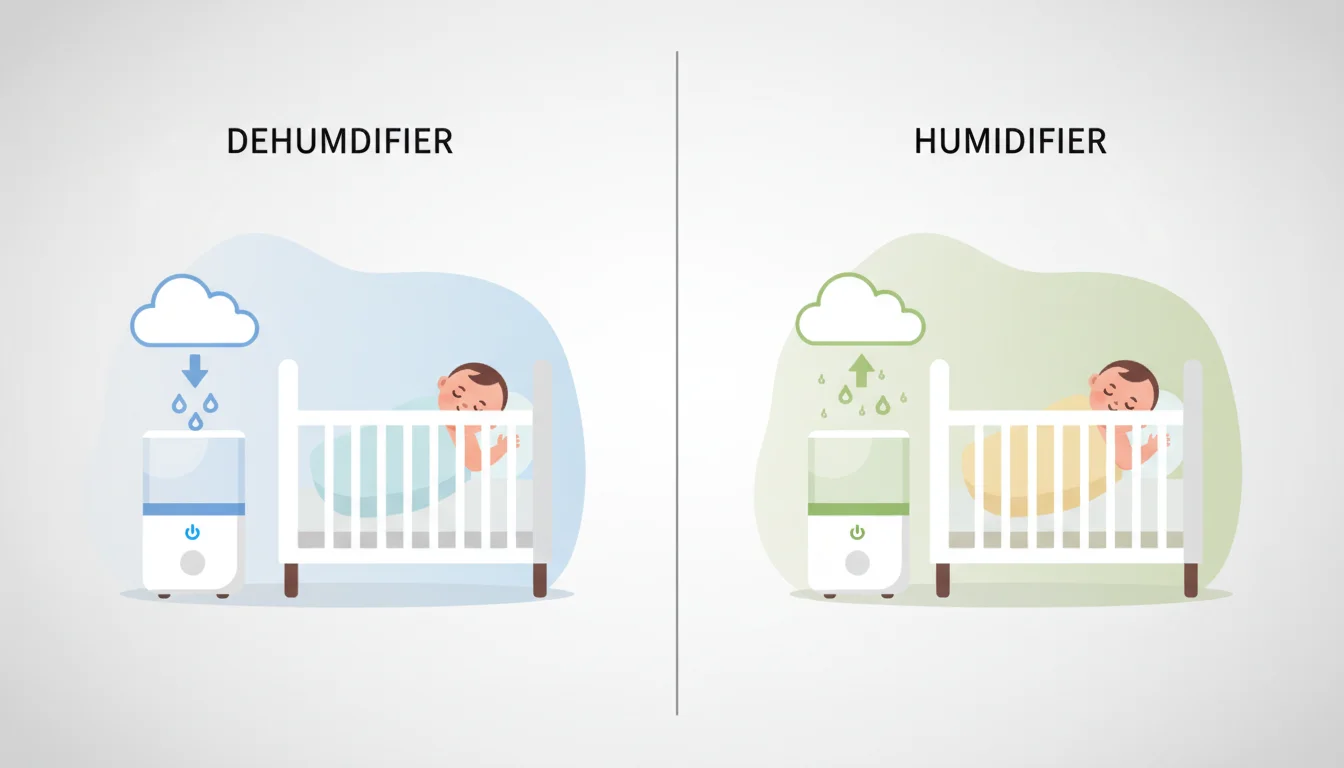
Humidifiers add moisture to dry air, while dehumidifiers remove excess moisture from damp environments. These devices perform opposite functions and address completely different problems in your baby's room.
| Feature | Humidifier | Dehumidifier |
|---|---|---|
| Primary Function | Adds moisture to air | Removes moisture from air |
| Best For | Dry climates, winter months | Humid climates, summer months |
| Targets Humidity | Below 40% | Above 60% |
| Common Types | Cool mist, warm mist, ultrasonic | Refrigerant, desiccant |
| Maintenance | Daily cleaning required | Weekly cleaning required |
Cool mist humidifiers release a fine, room-temperature mist into the air. Warm mist models boil water before releasing steam. Ultrasonic humidifiers use vibrations to create an extra-fine mist. For baby rooms, cool mist options are the safer choice since they eliminate burn risks entirely.
The key insight: neither device is universally "better." Your nursery's specific conditions determine which one you need. A $200 humidifier won't help if your problem is excess moisture.
Ideal Humidity Levels for Your Baby's Room
The sweet spot for nursery humidity sits between 40% and 60% relative humidity. This range supports healthy skin hydration, comfortable breathing, and reduces the survival rate of airborne viruses.
| Humidity Level | Effect on Baby | Action Needed |
|---|---|---|
| Below 30% | Dry skin, irritated nasal passages, increased congestion | Add humidifier immediately |
| 30-40% | Slightly dry, minor discomfort possible | Consider humidifier |
| 40-60% | Optimal range for infant health and comfort | Monitor and maintain |
| 60-70% | Dust mites begin thriving, stuffiness increases | Consider dehumidifier |
| Above 70% | Mold growth risk, respiratory issues likely | Add dehumidifier immediately |
A hygrometer costs under $15 and tells you exactly where your nursery stands. Place it at crib level, away from windows and vents, for accurate readings. Check it daily since humidity fluctuates with weather changes, heating cycles, and ventilation patterns.
Many parents learn the hard way that "feeling" the humidity isn't reliable. A room that feels fine at 8 AM might hit 70% by afternoon when the sun heats things up. Trust the numbers, not your instincts.
When to Use a Humidifier for Your Baby
Your baby needs a humidifier when indoor air drops below 40% humidity. This happens most often during winter when heating systems run constantly.
Signs your baby needs more humidity:
- Dry, flaky skin or eczema flare-ups
- Frequent congestion without other cold symptoms
- Chapped lips or dry nasal passages
- Coughing at night despite no illness
- Static electricity when touching blankets or clothing
Conditions that call for a humidifier:
- Winter months with forced-air heating
- Arid climates like the Southwest US or high altitudes
- Homes with wood-burning stoves or fireplaces
- Any time your hygrometer reads below 40%
The AAP specifically recommends humidifiers to help thin mucus and ease congestion in babies. Moist nasal passages trap germs more effectively, which explains why humidifier use often correlates with fewer respiratory infections during cold season.
Cool mist humidifiers are the only type recommended for nurseries. Warm mist models create burn hazards if knocked over. The [Cleveland Clinic] notes that dry air makes babies more vulnerable to illnesses ranging from bronchitis to sinusitis. In dry conditions, adding moisture is protective, not optional.
When to Use a Dehumidifier for Your Baby
Your baby needs a dehumidifier when indoor humidity consistently exceeds 60%, creating conditions where mold and dust mites thrive.
Warning signs of excess humidity:
- Condensation forming on windows
- Musty or damp odors in the room
- Visible mold spots on walls or ceiling
- Wallpaper peeling or bubbling
- Wood furniture warping or swelling
Situations requiring a dehumidifier:
- Humid coastal or tropical climates
- Basement nurseries or rooms below ground level
- Bathrooms adjacent to the baby's room
- Summer months in humid regions
- Any time your hygrometer reads above 60%
According to the EPA, humidity above 60% significantly increases mold growth and dust mite populations. Both are major triggers for infant allergies and asthma. The [CDC] reports that about 1 in 12 children in the U.S. has asthma, and environmental humidity control plays a key role in managing symptoms.
Dust mites reproduce rapidly above 50% humidity. Their waste particles become airborne and trigger allergic reactions. A dehumidifier won't kill existing mites, but it stops them from multiplying and makes the environment inhospitable for new colonies.
Safety and Placement Guidelines for the Nursery
Place humidifiers and dehumidifiers at least 3 feet away from the crib to prevent accidents and avoid directing airflow at your baby.
Placement rules:
- Position on a flat, stable surface that won't tip
- Keep all cords hidden behind furniture or secured to walls
- Elevate humidifiers slightly to improve mist distribution
- Never place on carpet where water damage could occur
- Ensure the device is out of reach as your baby becomes mobile
Cleaning requirements:
- Humidifiers: Empty and dry daily, deep clean every 3 days
- Dehumidifiers: Empty water tank daily, clean filter weekly
- Use distilled water in humidifiers to prevent white mineral dust
- Replace filters according to manufacturer schedules
- Inspect for mold growth in all water-holding components
Dirty humidifiers become mold factories that spray spores directly into your baby's breathing space. The [Environmental Protection Agency] indicates that evaporative humidifiers disperse fewer minerals than ultrasonic models, making them easier to maintain safely.
Cord strangulation is a real risk in nurseries. Run cords along baseboards and secure them with cord covers. Never let a cord dangle where a crawling baby could reach it.
Climate and Seasonal Considerations
Most families need both a humidifier and a dehumidifier, using each at different times throughout the year based on seasonal humidity shifts.
| Climate Type | Primary Need | Seasonal Adjustments |
|---|---|---|
| Desert/Arid (Southwest US) | Humidifier year-round | Possible dehumidifier during monsoon season |
| Continental (Midwest) | Humidifier in winter | Dehumidifier in summer |
| Coastal Humid (Southeast, Pacific Northwest) | Dehumidifier most of year | Possible humidifier with winter heating |
| Tropical (Hawaii, South Florida) | Dehumidifier year-round | Rarely need humidifier |
| High Altitude (Mountain regions) | Humidifier year-round | Monitor closely in all seasons |
Combination units exist that offer both humidifying and dehumidifying functions. These cost more upfront but save space and eliminate the need to swap devices seasonally. They're worth considering if your climate swings dramatically between seasons.
One important note: running both devices simultaneously in the same room wastes energy and creates conflicting conditions. If you own both, use them in different rooms or at different times based on your hygrometer readings.
FAQ
Do babies sleep better with a humidifier or dehumidifier?
Babies sleep better when humidity stays between 40% and 60%, regardless of which device achieves that level. Proper humidity reduces congestion, prevents dry throat irritation, and creates comfortable breathing conditions throughout the night.
Can I use a humidifier every night for my baby?
Yes, running a cool mist humidifier nightly is safe when indoor humidity falls below 50%. Monitor levels with a hygrometer to avoid over-humidifying, and clean the unit daily to prevent bacterial growth.
How close should a humidifier be to a baby's crib?
Keep humidifiers at least 3 feet from the crib to prevent direct mist contact and eliminate trip hazards. Position the device so mist disperses into the room rather than settling on bedding or the baby.
Are dehumidifiers loud enough to disturb baby sleep?
Modern dehumidifiers produce 30-50 decibels, similar to a quiet conversation. Many babies find this white noise soothing. Choose a unit rated for quiet operation if sound sensitivity concerns you.
What humidity level triggers mold growth in nurseries?
Mold spores begin germinating when humidity exceeds 60% for extended periods. Keeping humidity below 50% effectively prevents mold growth and reduces dust mite populations that trigger allergies.
Should I use distilled or tap water in my baby's humidifier?
Distilled water is strongly recommended. Tap water contains minerals that create white dust deposits on surfaces and potentially in your baby's lungs. Distilled water also reduces bacterial buildup in the tank.
How often should I replace my nursery humidifier?
Replace humidifiers every 1-2 years with daily use, or when mineral buildup becomes impossible to clean. Filters in evaporative models need replacement every 1-3 months depending on water hardness and usage.
Can high humidity make my baby sick?
Yes. Humidity above 60% promotes mold growth and dust mite reproduction, both linked to respiratory infections, allergies, and asthma symptoms in infants. Maintaining proper humidity is a health issue, not merely a comfort preference.
Share this post
Related Articles
Would a Dehumidifier Help With Asthma? What Science Says in 2026
Would a Dehumidifier Help With Asthma? What Science Says in 2026
Best Dehumidifier for RV: Complete Buyer's Guide for 2026
Best Dehumidifier for RV: Complete Buyer's Guide for 2026
Will a Dehumidifier Get Rid of Silverfish? Complete Guide to Humidity-Based Pest Control
Will a Dehumidifier Get Rid of Silverfish? Complete Guide to Humidity-Based Pest Control