Should Your Dehumidifier Be Upstairs or Downstairs? A Complete Placement Guide
Should Your Dehumidifier Be Upstairs or Downstairs? A Complete Placement Guide
Dehumidifier placement determines whether your unit removes moisture effectively or wastes energy fighting the wrong battle. Basements and ground floors typically register 10-20% higher relative humidity than upper levels due to ground moisture seeping through foundations. This guide walks you through measuring your home's humidity, identifying problem zones, and positioning your dehumidifier where it delivers real results.
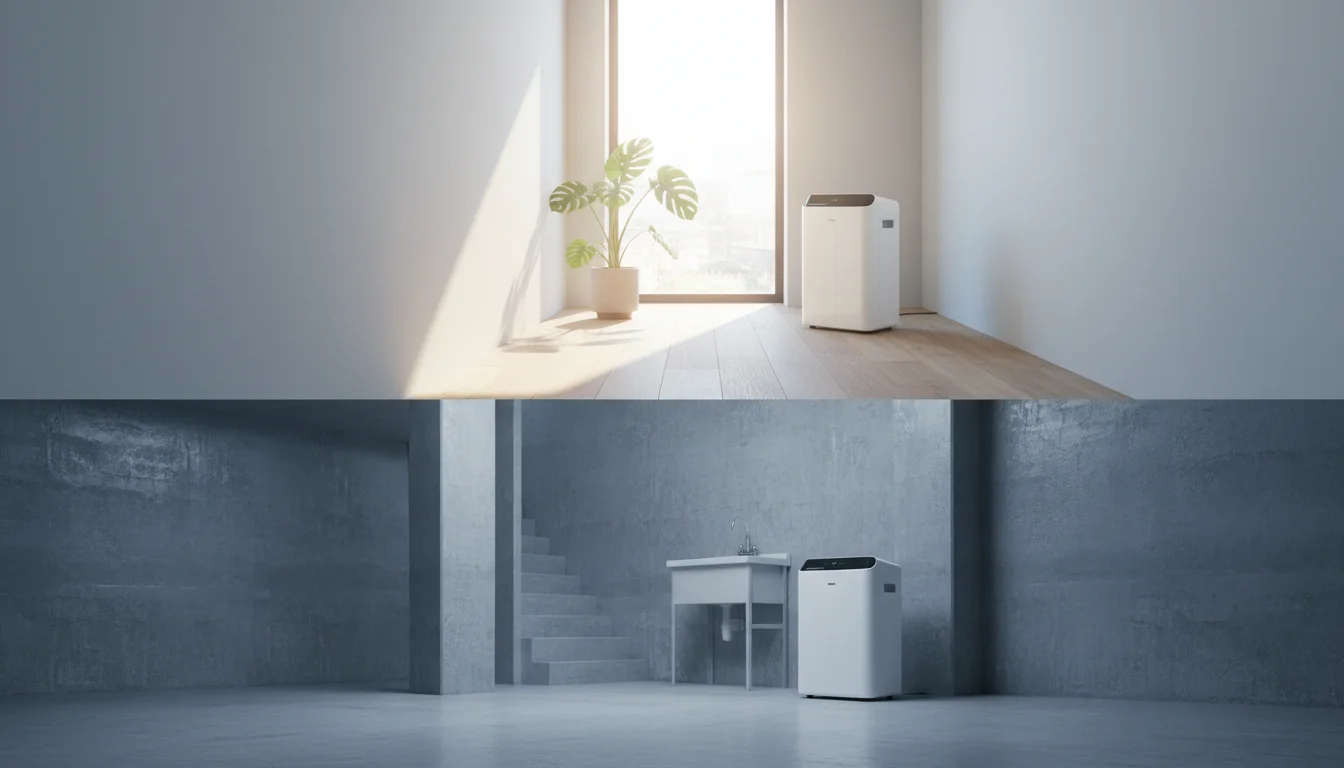
Understanding Humidity Differences Between Floors
Lower floors hold more moisture than upper levels in most homes. Ground contact, foundation seepage, and reduced air circulation create conditions where basements routinely exceed 60% relative humidity while upper floors hover closer to 50%.
The physics matter here. Warm air rises, carrying moisture upward from already-damp lower levels. Your basement acts as a moisture reservoir, continuously feeding humidity into the rest of your home.
Measuring humidity by floor level requires a hygrometer. Place one on each floor for 24-48 hours and record readings at the same time each day.
| Floor Level | Typical RH Range | Common Moisture Sources |
|---|---|---|
| Basement | 55-70% | Ground seepage, concrete walls, poor ventilation |
| Ground Floor | 45-60% | Foundation proximity, kitchen, laundry |
| Upper Floors | 40-55% | Bathrooms, trapped warm air, poor attic ventilation |
Your target sits between 30-50% relative humidity for comfortable living spaces. Anything above 55% creates conditions for mold growth and dust mite proliferation. ASHRAE sets this standard for indoor air quality.
I learned the hard way that feeling humid and measuring humid are different things. My upstairs felt worse, but my hygrometer showed the basement at 68% RH. Trust the numbers.
When to Place Your Dehumidifier Downstairs
Basements need dehumidification first in most homes. Ground moisture seeps through concrete foundations continuously, making lower levels the primary humidity source that feeds the entire house.
Signs your downstairs needs priority treatment:
- Musty odors that hit you when descending stairs
- Condensation forming on basement windows or pipes
- Visible mold on walls, floors, or stored items
- Peeling paint or efflorescence on concrete walls
- Wood furniture or boxes feeling damp to the touch
Concrete floors and walls absorb moisture like a sponge. [The Concrete Network] confirms that concrete holds significant moisture and releases it slowly into surrounding air. Your basement dehumidifier fights a constant battle against this moisture reservoir.
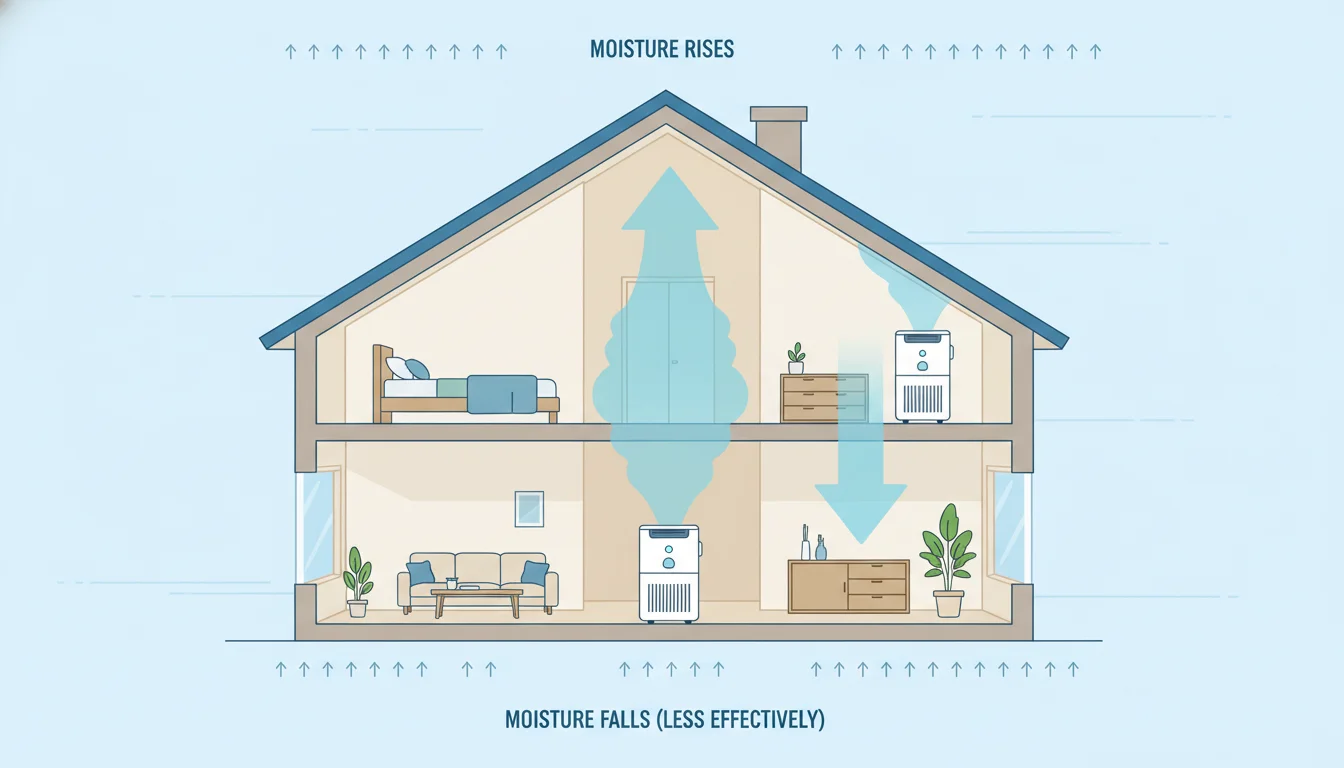
Treating moisture at the source stops humidity from rising through your home. Oransi notes that addressing basement moisture first is the most effective approach for whole-house air quality. A dehumidifier running downstairs prevents problems upstairs before they start.
Practical basement dehumidifier placement tips:
- Position the unit centrally for even air circulation
- Keep it 6-12 inches from walls for proper air intake
- Place it near the dampest area if moisture concentrates in one zone
- Use a unit rated for 20 pints per day or higher for typical basements
- Set up continuous drainage if possible to avoid daily emptying
Fair warning: basement dehumidifiers work hard. Expect to empty a 50-pint unit daily during humid months, or invest in a drain hose setup.
When Upstairs Placement Makes More Sense
Homes without basements flip the script entirely. Your primary humidity problems occur where moisture generates, making upstairs placement the logical choice.
When you place a portable unit in the basement, it has little to no effect on the upstairs. This insight from Oransi matters for slab-foundation homes where no basement exists to serve as a moisture collection point.
Upstairs placement makes sense when:
- Your home lacks a basement or crawl space
- Bathrooms generate excessive steam from showers
- Laundry rooms sit on upper floors
- Attic ventilation performs poorly
- Bedroom windows show morning condensation
- Upper floors feel muggy while lower levels stay comfortable
Bathroom proximity drives many upstairs humidity problems. A single hot shower releases significant moisture directly into upper-floor air. Position a compact dehumidifier near bathroom doors to intercept this moisture before it spreads.
Sleeping comfort matters too. Condensation on bedroom walls or windows signals humidity exceeding 60%. Stale air, muggy smells, or damp bedding indicate your bedroom needs direct moisture control. AlorAir recommends compact units for bedroom-specific use.
Poor attic ventilation traps moisture on upper floors. When air circulation between levels fails, upstairs humidity builds independently of basement conditions.
Central Placement and Air Circulation Strategies
Hallway placement lets one dehumidifier serve multiple rooms. Position your unit in a central location where air moves naturally between spaces.
Optimal dehumidifier location considerations:
- Central hallways on the problem floor
- Near HVAC return vents for enhanced distribution
- Away from corners where air stagnates
- At least 6-12 inches from walls
- Clear of furniture blocking airflow
Keep doors open. A dehumidifier in your hallway accomplishes nothing if bedroom and bathroom doors stay shut. Air needs pathways to reach the unit and return dehumidified to living spaces.
| Placement Strategy | Best For | Limitations |
|---|---|---|
| Central hallway | Open floor plans, moderate humidity | Requires open doors |
| Near moisture source | Bathrooms, laundry areas | Limited whole-room coverage |
| HVAC integration | Whole-house control | Higher installation cost |
| Corner placement | Space constraints | Reduced efficiency |
Fans improve distribution significantly. A ceiling fan or box fan creates air movement that helps your dehumidifier pull moisture from distant corners. Position fans to push air toward the dehumidifier intake.
For two-story house dehumidifier placement, consider your HVAC airflow patterns. Some systems push conditioned air upward, others downward. Work with your existing air movement rather than against it. Morris Direct emphasizes hallway placement for homes seeking whole-floor coverage from a single unit.
Single Dehumidifier vs Multiple Units: Making the Right Choice
One dehumidifier handles most homes under 1,500 square feet with a single humidity problem zone. Larger homes or multiple moisture sources require a different strategy.
You need multiple dehumidifiers when:
- Total square footage exceeds 2,000 square feet
- Humidity readings exceed 55% on multiple floors
- Air circulation between levels is poor
- Isolated moisture zones exist (basement plus bathroom)
- A single unit runs continuously without reaching target humidity
Dehumidifier capacity sizing guide:
| Room Size | Moderate Humidity (50-60%) | High Humidity (60-70%) | Very High (70%+) |
|---|---|---|---|
| 500 sq ft | 10 pints/day | 14 pints/day | 18 pints/day |
| 1,000 sq ft | 14 pints/day | 18 pints/day | 22 pints/day |
| 1,500 sq ft | 18 pints/day | 22 pints/day | 30 pints/day |
| 2,000 sq ft | 22 pints/day | 30 pints/day | 40 pints/day |
The cost-benefit calculation surprises most people. Two smaller units often consume less energy than one large unit running continuously. They also provide redundancy if one fails.
AlorAir confirms that without significant airflow between spaces, multiple dehumidifiers prove more effective than a single unit working overtime. For two-unit setups, place one in the basement and one on the main living floor, or one downstairs and one near upstairs bathrooms.
Seasonal and Climate Considerations for Placement
Summer humidity affects all floors more equally as outdoor moisture infiltrates everywhere. Winter concentrates moisture in heated living spaces where people spend time.
Seasonal dehumidifier placement adjustments:
| Season | Primary Concern | Recommended Focus |
|---|---|---|
| Summer | Whole-house humidity | Basement or central placement |
| Winter | Condensation in heated rooms | Living areas, bedrooms |
| Spring | Ground moisture rise | Basement priority |
| Fall | Transitional humidity | Monitor both levels |
Regional climate shapes your permanent setup. Gulf Coast homes need year-round basement dehumidification. Pacific Northwest homes battle winter moisture differently than Arizona homes dealing with monsoon season.
I move my portable unit seasonally—basement from April through October, upstairs hallway during winter months. This approach matches where moisture accumulates rather than running two units year-round.
FAQ
Where should I put a dehumidifier in a two-story house?
Start in the basement or lowest level where humidity measures highest. Use a hygrometer to confirm which floor needs treatment. Most two-story homes benefit from ground-level placement since moisture rises from below.
How far from the wall should a dehumidifier be placed?
Keep your unit 6-12 inches from walls and furniture. This clearance allows proper air intake and exhaust. Restricted airflow forces the compressor to work harder and reduces moisture removal efficiency.
Can one dehumidifier work for an entire house?
A single unit handles homes under 1,500 square feet with good air circulation between rooms. Open interior doors and use fans to help air reach the dehumidifier. Larger homes or those with poor airflow need multiple units.
Should I run my dehumidifier 24/7?
Run it until humidity drops below 50%, then use the built-in humidistat to cycle automatically. Continuous operation wastes energy once you reach your target humidity. Most units include automatic shutoff when the collection tank fills.
What humidity level should I set my dehumidifier to?
Target 30-50% relative humidity for living spaces. Basements tolerate slightly higher levels around 50-55%. Settings below 30% feel uncomfortable and stress wooden furniture and flooring.
Does a dehumidifier cool a room?
Dehumidifiers produce slight heat from their compressor operation. However, lower humidity makes air feel cooler because sweat evaporates faster from your skin. The perceived cooling effect outweighs the minimal heat output in humid conditions.
How do I know if my dehumidifier is working properly?
Check the collection tank daily. A working unit in a humid space collects several pints within 24 hours. Use a hygrometer to verify humidity drops over time. No water collection in a humid room signals a problem.
Should I close windows when running a dehumidifier?
Close windows and exterior doors to prevent outdoor humidity from entering. Your dehumidifier fights a losing battle against continuous moisture infiltration from outside. Run it in a sealed space for best results.
Share this post
Related Articles
Would a Dehumidifier Help With Asthma? What Science Says in 2026
Would a Dehumidifier Help With Asthma? What Science Says in 2026
Best Dehumidifier for RV: Complete Buyer's Guide for 2026
Best Dehumidifier for RV: Complete Buyer's Guide for 2026
Will a Dehumidifier Get Rid of Silverfish? Complete Guide to Humidity-Based Pest Control
Will a Dehumidifier Get Rid of Silverfish? Complete Guide to Humidity-Based Pest Control